Latest posts

Hjördis post, January 2026

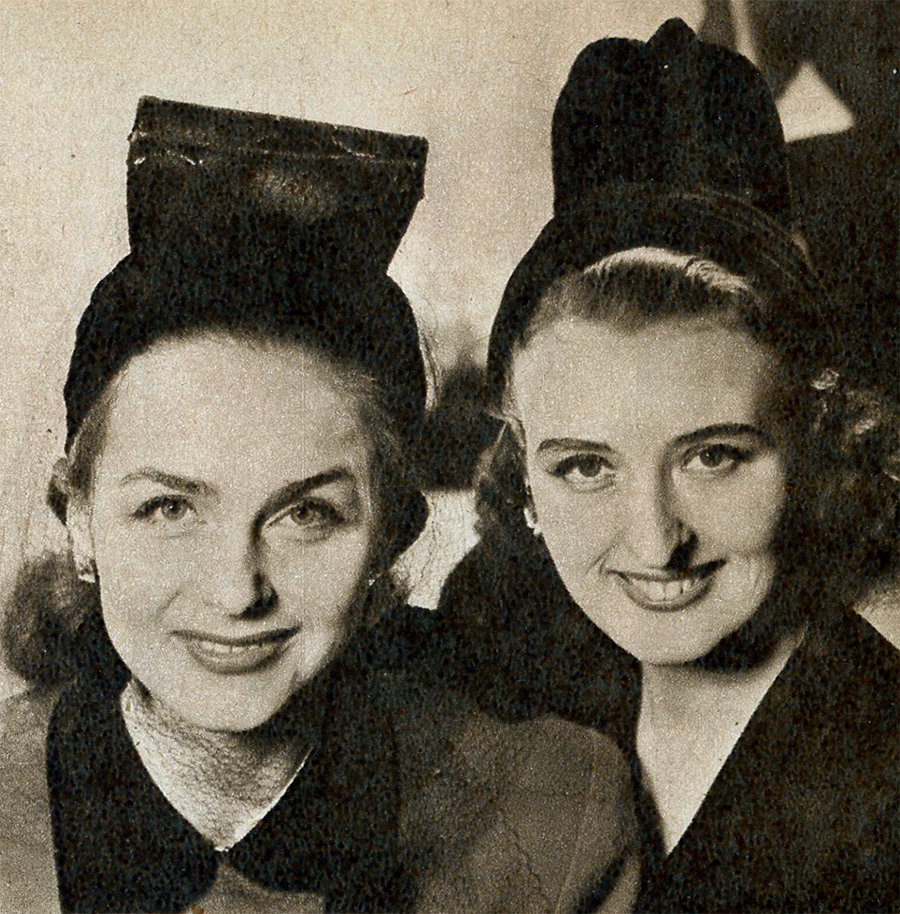
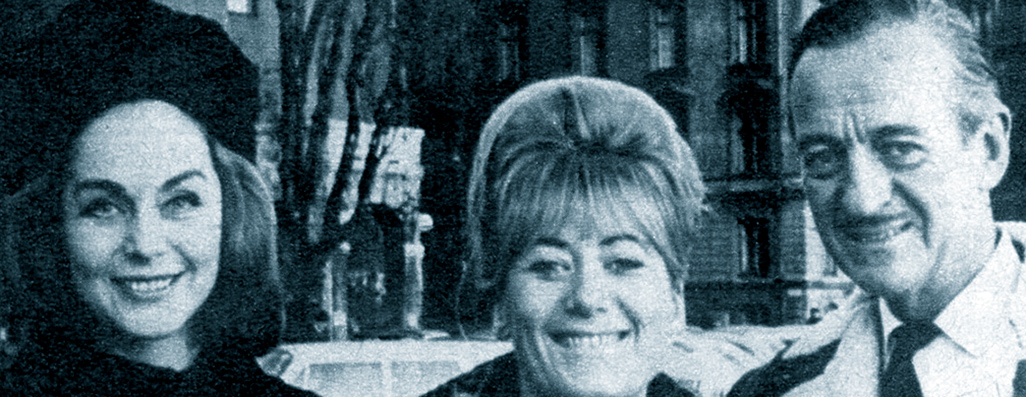
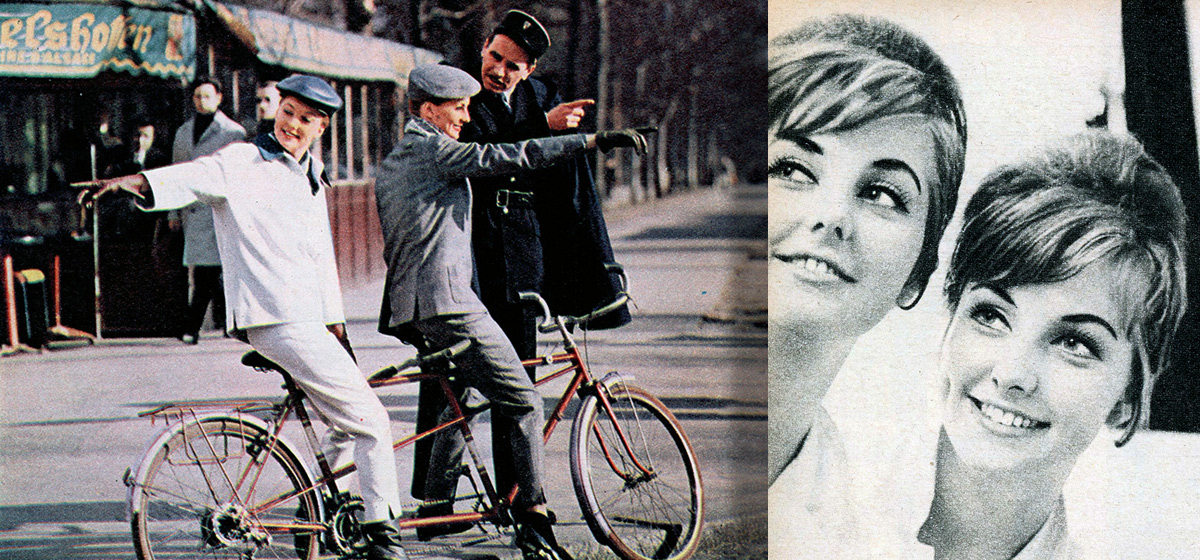
Pia and Mia Genberg photographed in Paris, 1961

Maj-lis Genberg

Hello everyone. Sorry to start with the sad news that Hjördis’ niece, Maj-lis (Mia) Genberg, passed away in 2025. Her twin sister Gudrun (Pia) died in 2020.

The twins worked as models in Sweden before gaining fame in 1959 as Folies Bergère showgirls in Las Vegas. After their return to Europe, they enjoyed huge success as Jean Patou fashion models in Paris, with an additional reputation for changing outfits with astonishing speed, until audiences realised they were twins.

The article below appeared in Hemmets Veckotidning after an early 1961 visit by the magazine’s Paris correspondent, Greta Merlier. It captures a snapshot of the teenagers’ lives as they prepared to move from modelling careers in Paris to movie careers in Rome.

Pia and Mia Genberg, in Paris, 1961

“Pia and Mia Genberg have been inseparable for 19 years—and they love it. Their shared, double dose of charm has taken them to the fashion houses of Paris, where they stroll hand-in-hand through the showrooms, greeted with cheers from enthusiastic audiences. Next up: trips to Rome and Morocco to act in movies.

Pia was born first. Ten minutes earlier, to be exact. Pia’s eyes have a bit more violet in them. Both sisters have deep dimples when they laugh, but Pia also has one near her eye. “That’s not a dimple,” she says. “It’s a scar—from when I fell into the bathtub as a toddler.”

Mia is slightly fairer. But are those really their names? Not exactly. Foreign journalists who struggle with their tricky Swedish names gave them those nicknames. Their full names are Gudrun (Pia) and Maj-lis (Mia) Genberg. Their Aunt Hjördis is married to David Niven—just in case anyone in Sweden still doesn’t know that fun fact.

Right now, they’re in Paris modelling clothes for Patou.

“We’re getting our hair done by a top stylist before tonight’s dress rehearsal—come with us…”

Gudrun and Maj-Lis (Pia and Mia) Genberg. Paris, 1961.
Gudrun and Maj-lis (Pia and Mia) Genberg. Paris, 1961.

The hairdresser has his salon near Rond Point. He melts with pride when faced with these Nordic beauties, their permed locks ready to be styled. He brushes and curls their hair, pins it up, and repeats the process multiple times. The girls are patient and calm. Fifty thousand pins might be needed to hold it all together. That’s just how it is here.

After two hours, they look like someone who’s been out in a hurricane. “Voilà,” says the strong-armed Figaro, but they’re not quite convinced. They pay their 35 francs and are told they got a “double discount.”

During this time, they had their portraits taken, which made them nervous. You never know how the twins will turn out in photos—especially when one insists on being photographed from the right side. The next day, the photos were reviewed and approved.

Patou kicked off the fashion show with a bang. The models were stunning, the setting was elegant, and the show lasted an hour, with the twins making several appearances. Jolie’s assistants were amazed. “We’ve never seen anything like this,” they said. The girls were proud of their product.
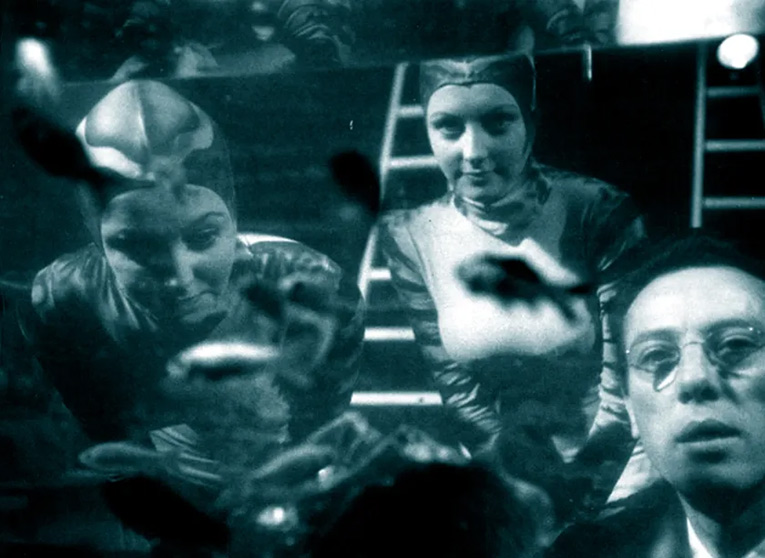
Pia and Mia Genberg modelling frog costumes for French movie director Jean-Paul Sassy, 1961.

Paris is very into the twins. People chase the duo down the street, snapping photos and asking for interviews. Radio and television have been all over them. They sang “Små grodorna” (“Little Frogs”) and “The Girls from Småland” in Swedish—it takes quite a bit of fame to get “The Girls from Småland” played on French radio. But Mia and Pia pulled it off.

They love food. Yet they have 55 cm waists and figures that outshine both Monroe and Bardot.

Meatballs, oh how I miss meatballs… and falukorv (smoked sausage), herring salad, and mashed rutabaga (swede),” Pia adds.

They’re simple, natural, and easygoing. Back home in Farsta, people don’t make a big fuss over them. Their eyes don’t light up when talking about Las Vegas, boys, or clothes—but mention mum’s cooking or Bernardo’s meals, and they beam. (Bernardo is David Niven’s chef.)
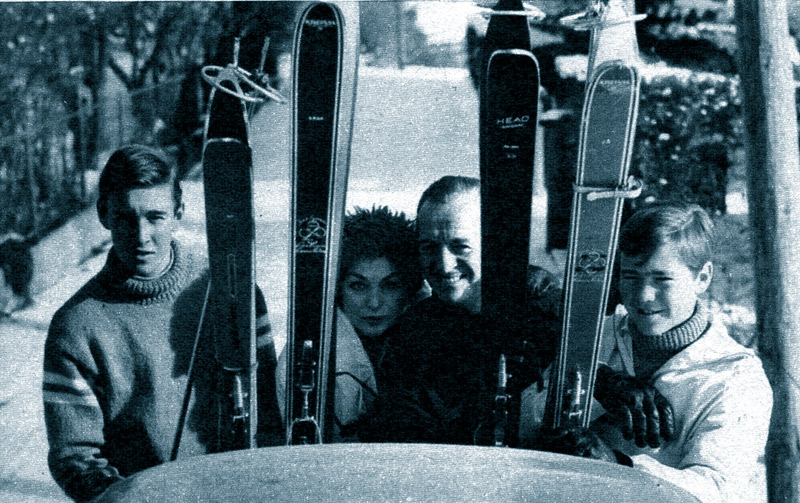
David Junior, Hjördis, David and Jamie Niven in Switzerland, December 1960

“We had such fun when we visited them in Switzerland a month ago. They have a villa in Château d’Oex. We all went skiing—and we all fell down. It’s beautiful there, and not too high up, so you don’t lose your breath.”

[Hjördis was not put off, and fell again in 1962, breaking her leg in fifteen places. Her injury slowed her down when John F Kennedy decided to play ‘chase’ in 1963.]

In December 1960, Hjördis and the twins surprised David with a Lucia celebration. He had no idea! They found white robes, made wreaths for their hair, and whipped up something that resembled lussekatter (Lucia buns). They spent all night preparing the tray, getting dressed, and fixing the candles. Then they woke him up at an ungodly hour with their Lucia procession.

You can easily imagine David Niven’s shocked expression when three candlelit girls show up at dawn. But he didn’t stay in character—he joined in the Lucia celebration.

“He’s so sweet. He gave us a trip home as a Christmas present,” they say. “And Hjördis gave us these,” the girls add, showing off cute gold watches hanging from long chains around their necks—just the thing if you want to stay fashionable.

People have written that you like aquavit? (a traditional Scandinavian distilled spirit, similar to gin)

“Ugh, yes, they write so much nonsense. Have we said that we like aquavit? We only drink milk and Coca-Cola. But it’s true that we enjoy sleeping in late in the mornings—when Louis doesn’t start singing!”

Mia and Pia Genberg on a lunch-break with their minder, French wrestler Lucien Fleurot.

Louis is a Spanish jack-of-all-trades who came with the apartment they were given. But Louis isn’t the only one catering to them—they also have a manager who doubles as their photographer, Gérard Décaux, two secretaries (one Swedish, one French), and a massive bodyguard named Lucien, a former French wrestling champion. Last year, Lucien stood like a wall between Brigitte Bardot and the French press when she was expecting her baby. That was nothing compared to looking after the twins.

Lucien rarely has both girls under control at the same time—one always sneaks off, and they blame each other. Poor Lucien can’t tell them apart and is on the verge of a nervous breakdown. Photographer Gérard Decaux has ordered him never to let either girl out of his sight—not so much for safety, but for publicity!

Lucien also works as a stuntman in films that require daring action scenes. But he wouldn’t dare raise his voice at Pia or Mia. Their angelic charm hides a mischievous streak. They’re never rude, never sick (knock on wood), and when one dreams something, the other dreams it too.

Do they like Paris?
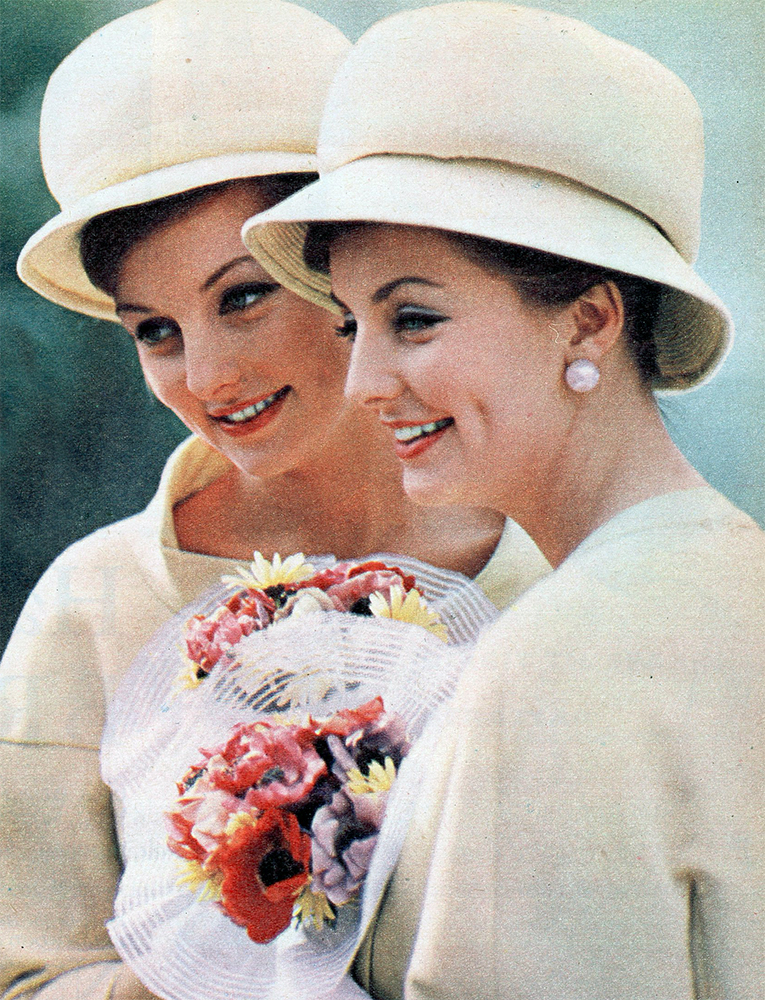
Pia and Mia Genberg, Paris 1961

“Oh yes! But it’s a bit sad— In Paris, there’s so much tempting shopping, but we can’t afford it.”

The twins invited guests to a party at their home one Sunday. Technically, it’s the home of Gérard Décaux, the impresario-photographer, but he had lent out the flat and was staying at one of the hotels owned by his parents in the meantime. Gérard is a skilled photographer. We counted twelve cameras, and his photos and cover girls from all nationalities adorned the walls.

Guests chatted about quiz shows—favorite sports, actors? The twins answered sweetly: blue, ice skating, swimming, horseback riding, and skiing. Their top favorite? David Niven. Then Elvis Presley, Marilyn Monroe, and Shirley MacLaine. Their upcoming plans included a two-day visit with the Nivens in Switzerland and a role in the film The Last Days of Sodom and Gomorrah, starring Anouk Aimée, Pier Angeli, Stewart Granger, and Stanley Baker.

Like many young women, the twins dream of America and Hollywood. They’ve had offers—so why not? I’m pretty sure they’ll make those dreams come true.”

For more about Gudrun and Maj-lis, we have a page dedicated to both of the twins.


Slightly surreal thanks to Copilot for help with the translation, though I’m pretty sure the Swedish-to-English for Marilyn Monroe isn’t “Maria Montez.” And goodness knows why it decided to insert “science fiction in England” into the twins’ plans between visiting the Nivens in Switzerland and going to Rome.

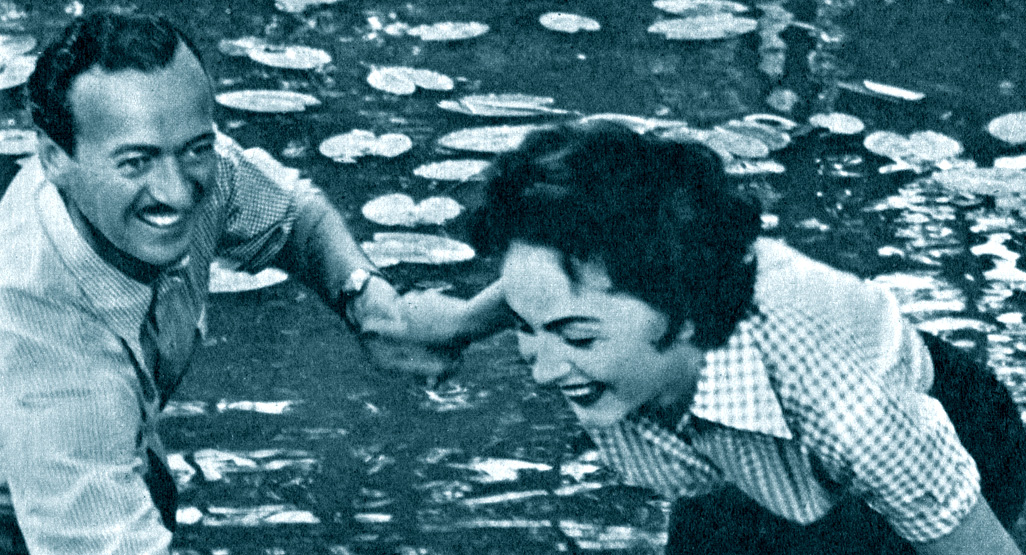
That said, Copilot did a very good job of aligning a very out-of-register photo used near the top of this page. For anyone interested, here are the before and after:


Guest star for three seconds

Well, I’ve finally found Hjördis’s last Swedish movie appearance: 1945’s “Brita i grosshandlarhuset” (Brita in the Merchant’s House), only available on DVD as part of a four-movie box set. She is listed in IMDb as playing the (uncredited) part of an officer’s wife.

Her appearance lasts for about three seconds, swooping into a chauffeured car outside her workplace, the NK store in Stockholm, as an open-mouthed Brita (recently arrived country girl) looks on. I guess Hjördis was listed as an officer’s wife because she was about to become one in real life. There is no sign of an officer in the scene. Anyway, here it is…

The story would have had some resonance with Hjördis. In short, Brita is the daughter of a poor crofter who arrives in Stockholm by train, clutching her suitcase, is awed by the sight of NK, and then sets off to report for work as a maid at the home of a wealthy businessman living on the Strandvägen. (Where Hjördis actually lived). She falls for the son of the house, but can they bridge the social divide?… Etcetera.

Filming on ‘Brita i grosshandlarhuset’ was completed on 28th November 1945, but Hjördis was not in Sweden for its premiere in February 1946.

“And so it was. I refrained from a possible career as an actress, and we started making plans for the future. It was decided that Carl Gustaf would travel to South America and that I would come over later and meet him in the US. “


Swedish Spring fashions in 1945
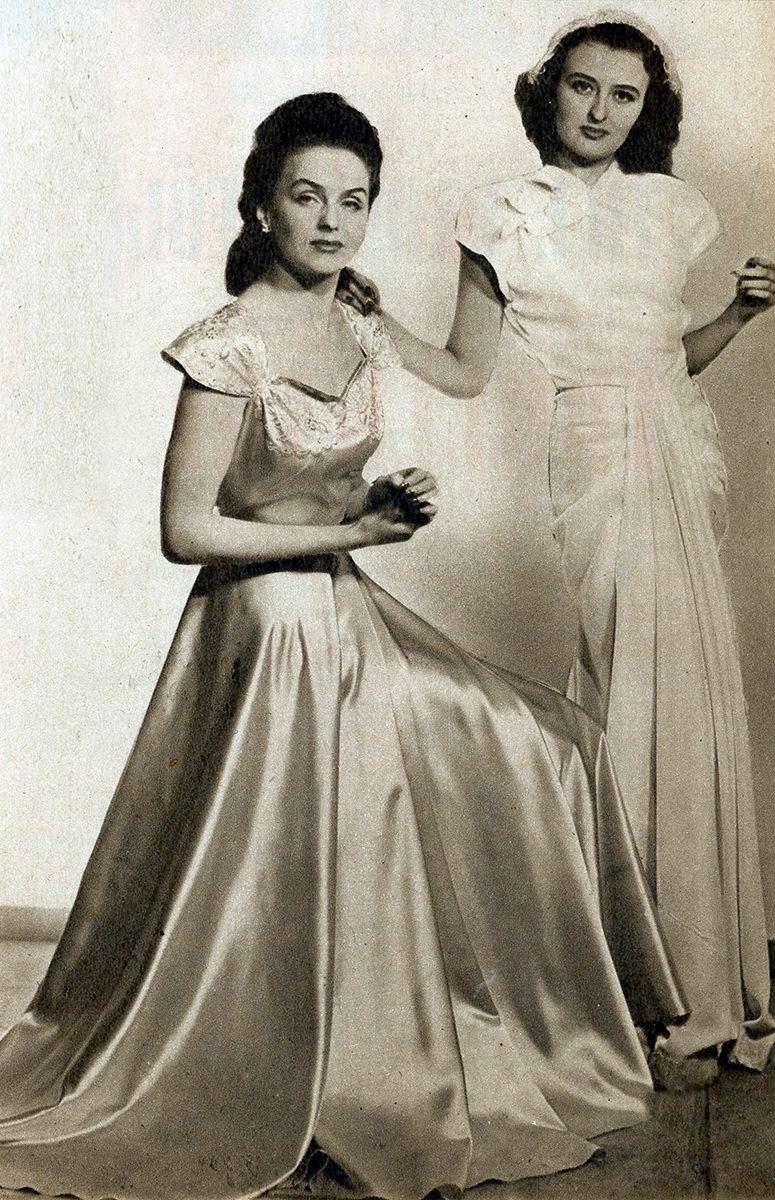
The March 1945 issue of Veckojournalen magazine featured a preview gallery of Swedish spring fashions, modelled by the country’s two premier models: recently engaged Hjördis Genberg and Sweden’s Twiggy, Kim Andersson, whose nickname was “The Plank”. “Twiggy” sounds better.

The new fashions were described by both Kim Andersson and Hjördis Genberg as “lacking any revolutionary ideas.” However, Sweden’s years of isolation and an easing of rationing were having an impact.

“The suit, as well as the dress, has now become the backbone of the wardrobe—whether inspired by American-style strict military uniforms or more imaginative romanticism. A characteristic of spring’s fashion commentary is also that they come in both full and three-quarter lengths. For evening dresses, Kim Andersson suggests the comeback of the fan (a long-forgotten detail) now welcomed as a sweet, decorative element.” So, military uniforms and a fan.

More about Swedish fashion in the 1940s, and wartime Sweden 1939-1945.


And that’s all for this post. If you’ve made it this far down the page, well scrolled. And Happy New Year!
Hjördis post, October 2024

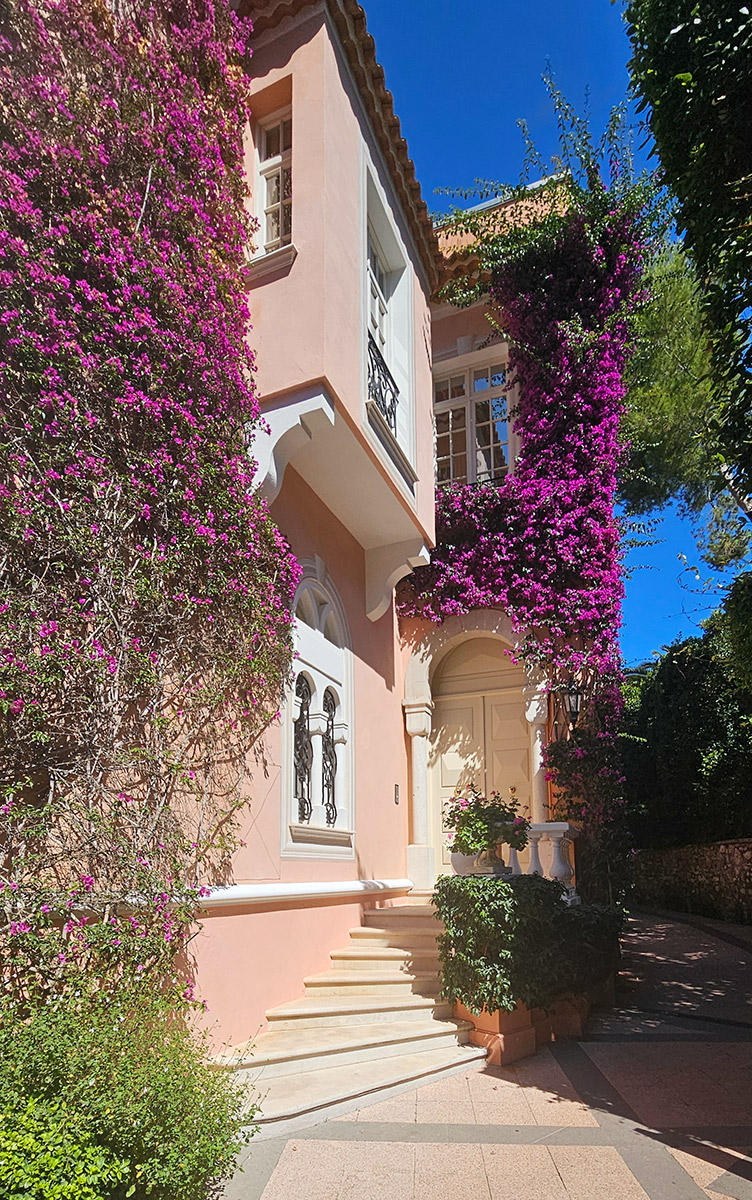
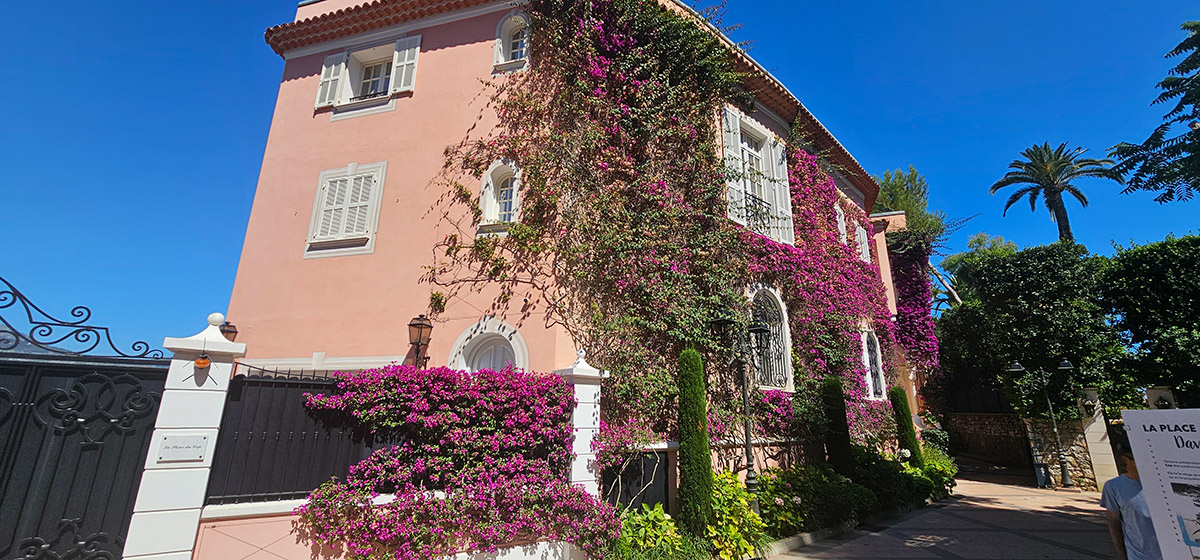
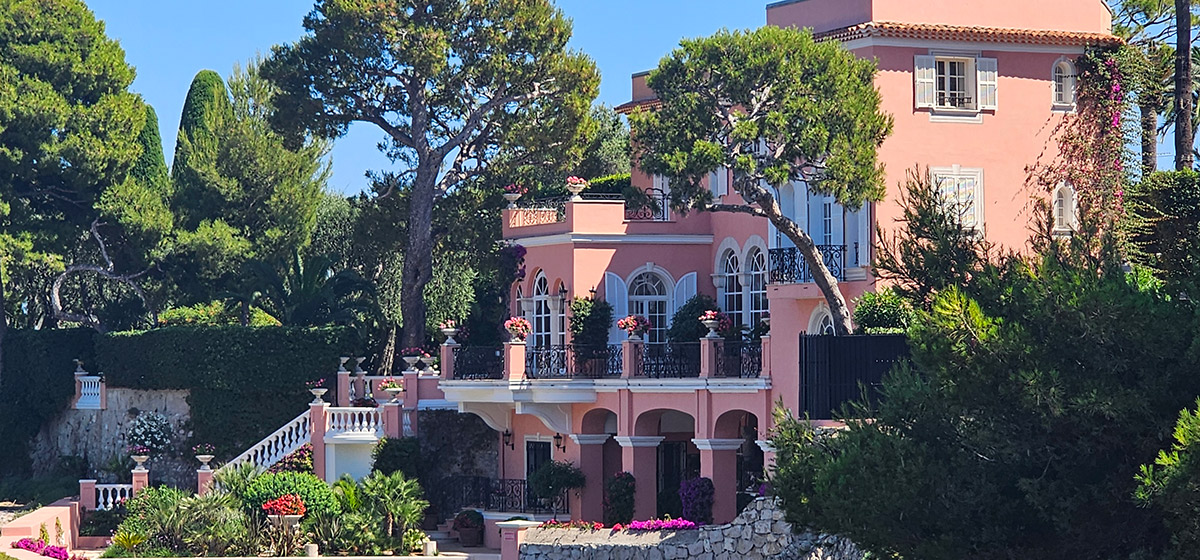
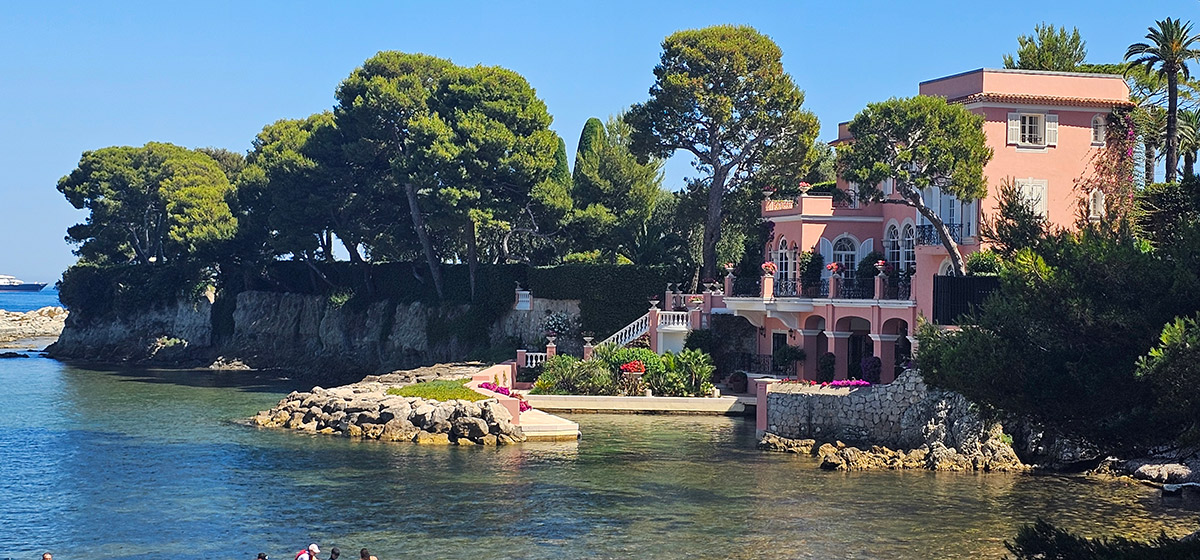
Fleur de Cap, Cap Ferrat, July 2024
‘Fleur de Cap / Lo Scoglietto’ in July 2024. Photo: Carlos Madrid

Hello! It’s been far too long since my last post. There is semi-regular activity on hjordisniven.com, but we’ll concentrate on upcoming content:
It’s a mystery

Something that doesn’t look as if it’s upcoming is a movie project mentioned last year called ‘Chalet’, based on a murder/mystery play written by the late journalist Roderick Mann, with actors playing the parts of David and Hjördis. Magus Films still has some details, but the movie’s website has mysteriously disappeared.

Killed by a velvet snake

When researching Hjördis’s life in books, magazines, and newspapers, it’s common to discover different versions of the same story. Of course, many biographical articles were constructed (then embellished) from earlier sources. It’s interesting to piece together the sources and see if they lead back closer to the original pieces.

One such is the story of how teenage Hjördis was ‘discovered’ by a Swedish filmmaker and explorer named Gösta Gerring. I’ve previously recounted a 1952 version, as told by Allas magazine. An older version, from Vecko Revyn in 1948, has now appeared.

“On a cold and windy February day several years ago, the photographer and explorer Gösta Gerring walked along a small back street in Söder. He was out to make a home movie report about everyday life and people. A cafe sign shone towards him in the twilight. He stepped into the hot and smoky room, hung his hat and coat on a hook and ordered a coffee and bread from the young waitress.”

“The coffee arrived, and Gerring nodded an indifferent thank you. But then he happened to cast a glance at the girl who was serving him. She was young, perhaps no more than 16, with hands used to work, an unpainted face, and straight hair in an indeterminate hairstyle. But she had a beautiful figure and bearing, long, slender legs, and her face seemed peculiarly attractive. When she smiled at him, he saw that her teeth were unkempt and thought to himself: pity the sweet girl. He asked to film her at work in the cafe, and she shyly agreed. When he was done, he thanked her and left.”

“A few years later, he saw her again. It was dance night at the Cecil restaurant, and suddenly, he saw a lovely young girl walking between the tables, escorted by a gentleman in a tailcoat. Suddenly, she saw Gerring, hesitated momentarily, and walked briskly to his table. ‘Good day, Director Gerring, do you remember me? You were so nice to me once upon a time when I worked at Söder, I just wanted to say hello and remind you of old times.”

“She smiled at him with dazzling white teeth and walked on with her beautiful head held proudly high. Gösta Gerring smiled to himself and remembered Hjördis Genberg as he had last seen her. Now, how had this transformation come about?”

Allas chose a much more romantic version of the scenes, adding dialogue but leaving out the unflattering descriptions of poor Hjördis’ indeterminate hairstyle and unkempt teeth (!)

Gerring must have told the story in an earlier article. He died in Guatemala in 1946 after being bitten by a venomous velvet snake (Bothrops asper) and apparently bled to death. Delightful.

Hoi, those are my underpants!

Hjördis Niven and the Niven family's cook
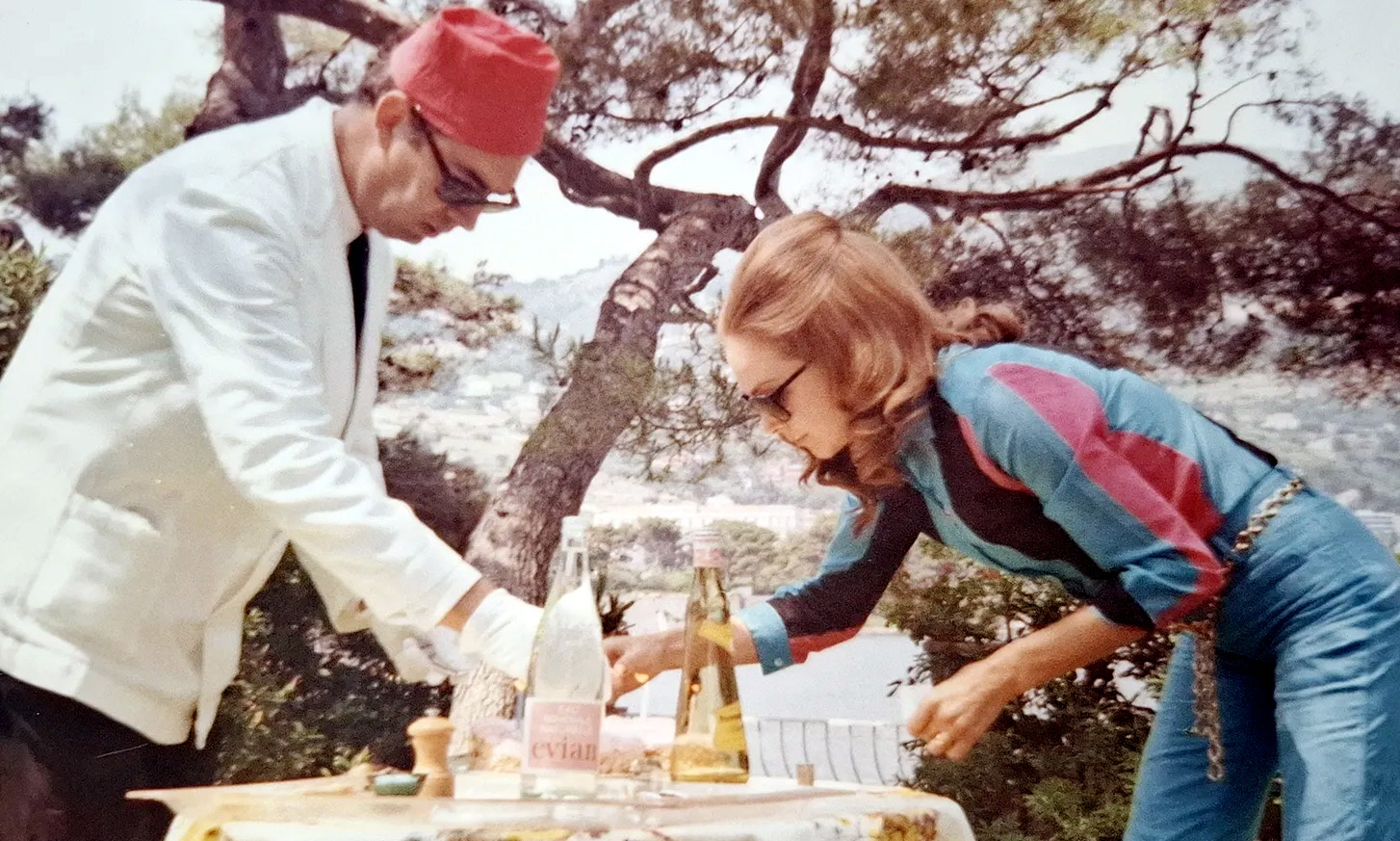
Eduardo Moreda and Hjordis Niven. Lo Scoglietto, 1965. Photo: Patricia Novoa Moreda

The August 2024 Spanish version of Vanity Fair has an interesting article about Nina and Eduardo Moreda, who worked as cook and maître d’ for the Nivens at Lo Scoglietto from 1965 to 1971. The page includes Moreda family photos from the time.

Hjördis’ niece Anette remembers another of the Nivens’ staff, Bernardo, the Italian cook and butler who may have been Nina and Eduardo’s predecessor.

“Bernardo was fun, always happy and singing. I remember him watering the plants in the big garden. He used to do it early in the morning while only wearing underpants. Jamie was irritated because Bernardo was using his underpants, taken from the laundry.” [Burn those knickers Jamie!]

Roderick Mann wrote that Bernardo deliberately got himself fired by drilling a hole in Hjördis’ tea cup.

Cap Ferrat 2024

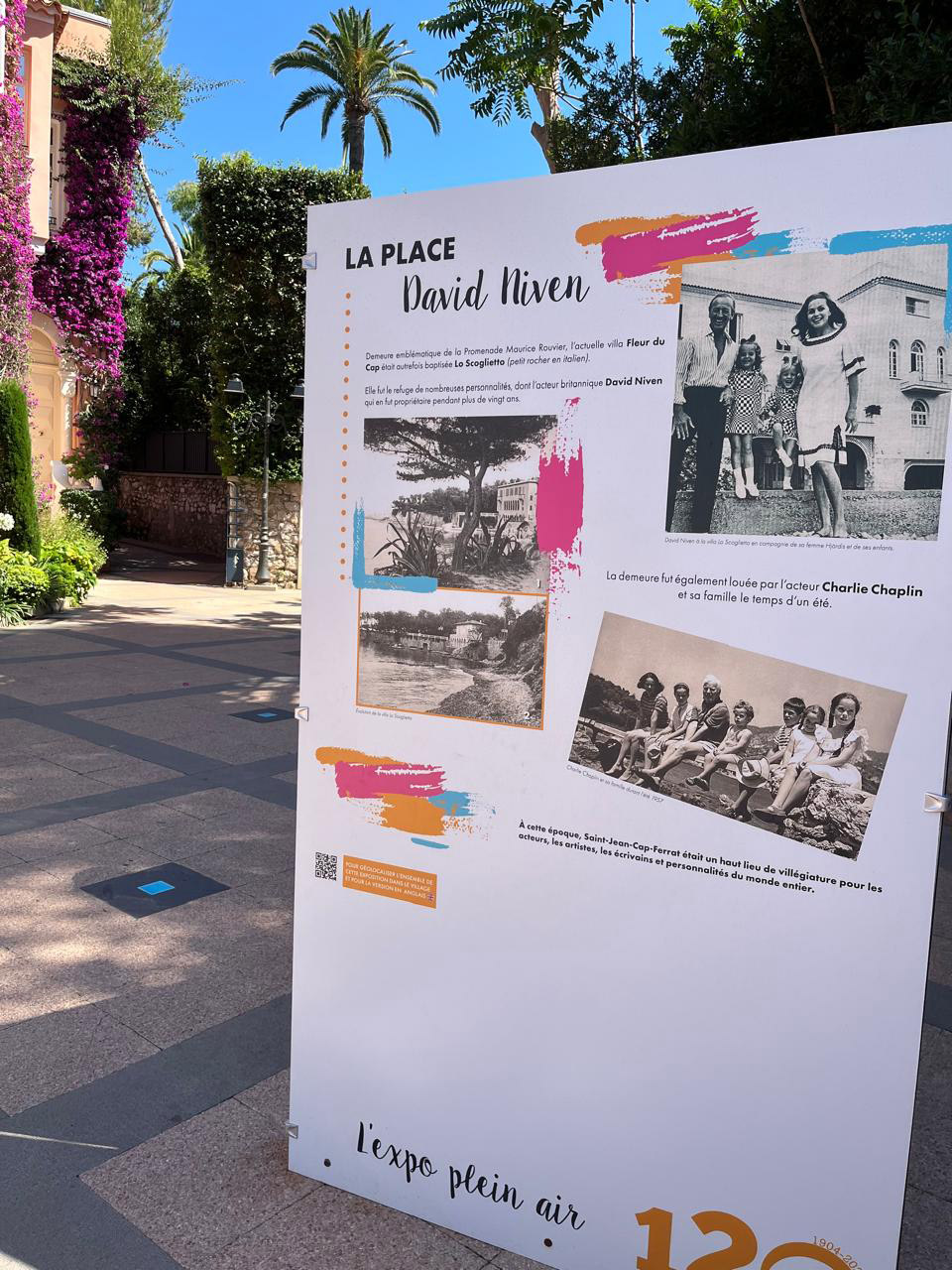
Carlos Madrid visited Cap Ferrat in July 2024 and has shared some lovely photos of Fleur de Cap (Lo Scoglietto). Since 2023, an information board has been added to ‘La Place David Niven’ outside the house’s gates. The board includes photos of David and Hjördis, including one copied from hjordisniven.com.

Hjördis post, April 2023

A view of Lo Scoglietto’s garden and rotunda. Cap Ferrat, January 2023

Hello! It’s been a while since my last post, but there has been a lot of activity on hjordisniven.com.

The newest page is a gallery of photos documenting a visit to Cap Ferrat in January 2023, and a stroll past David and Hjördis’ old summer residence ‘Lo Scoglietto’, now called ‘Fleur de Cap’. It feels like a really special area. (Reflected in the prices in the windows of local estate agents!)

For vintage views of Lo Scoglietto, check out ‘Lo Scoglietto – The little rock‘ for Hjördis’ description of the house and its 1960s renovations.

Hjördis Niven, journalist Margareta Hernberg and David Niven, 1963
Hjördis Niven, bee-hived journalist Margareta Hernberg, and David Niven. 1963

The Nivens at Lo Scoglietto, 1967‘ tells the story of a visit to ‘Lo Scoglietto’ by Swedish journalist Margareta Hernberg. It also manages to highlight Hjördis’ paranoia about leaving David in the company of a young female jourmalist.

Margareta had previously revealed a real talent for getting below the glossy surface of the couple’s relationship. Which was usually inpenetrable.

Her Women’s World interview from 1963 shone a light on David’s reluctance to let Hjördis have a movie career, even when one was dropped onto her lap after an appearance in the tv drama ‘Safe Keeping‘…

“The day after the program we were completely overwhelmed,” David remembered. “Of course, it concerned offers for Hjördis. It’s been about six or seven years now, but I still haven’t gotten over it. You work year in and year out, hoping that you develop in your profession. And then one’s wife, a complete novice, comes and makes a single appearance. Great success!”

“And I was kind enough to interrupt a promising acting career in order not to compete with you,” was Hjördis’ response. A real ‘joke with a jab’.

Jamie Niven podcast interview

In 2021, David’s son Jamie took part in a frank podcast for the Partnership To End Addiction, discussing alcohol problems that lasted from his teens to his sixties.

Among other revelations, he mentions how a friend helped him to understand his father’s attitude to perceived competition: “He was a narcissist, and narcissists can’t tolerate the success of the other around them.”

The podcast’s headline is: “Despite being the son of an Academy Award-winning actor, Jamie Niven’s life wasn’t all glitz and glamour. At just six months old, Jamie’s mother passed away, leaving Jamie to grow up with an overwhelming feeling of loneliness – a feeling that followed him for his entire life.”

Hjördis was not named or even alluded to, but she could surely have done more to fill the void in Jamie’s life.

“Hjördis was more of a companion rather than a mother,” Jamie told Sheridan Morley in the 1980s. “She didn’t act like a mother and she made it very clear that she never wanted to be our mother.” (The perfect wife and mother, 1949-1950)

Hjordis Niven in Pacific Palisades, 1948
Hjördis Niven in Pacific Palisades, 1948

And now, something about friendship in Hollywood. Gene Tierney’s husband, Oleg Cassini, had plenty to say on the matter:

“Friendship among stars was a curious phenomenon. Gene had no friends who might be considered competitors, and this was quite typical. She could be friendly with older women, and men, but no-one her own age really. This was true among male stars as well. The big ones expected to be treated like royalty; each was a sun, with various dimmer satellites swirling about him. For a time I sought to become friendly with Errol Flynn – we played tennis together, his natural dash and flamboyance appealed to me – but it wasn’t possible. Like most big stars, Flynn expected deference from his friends. His circle included lesser stars like Bruce Cabot and David Niven, none of whom questioned his suzerainty.”

For more Oleg, and Hjördis’ impressions of the 1940s-50s Hollywood social scene: May I introduce… Mrs David Niven

Concept posters for the ‘Chalet’ movie project

Meanwhile, somewhere in a pipeline, a project is taking shape to adapt a play written by the late journalist Roderick Mann into a movie. ‘Chalet’ is set in December 1975, and was apparently based on Hjördis’ behaviour towards David in his last days.

The project’s website: https://chaletmovie.com (No connection to hjordisniven.com!)

And that’s all for this post! Until next time, take care, and check the updates page.

Hjördis post, August 2022

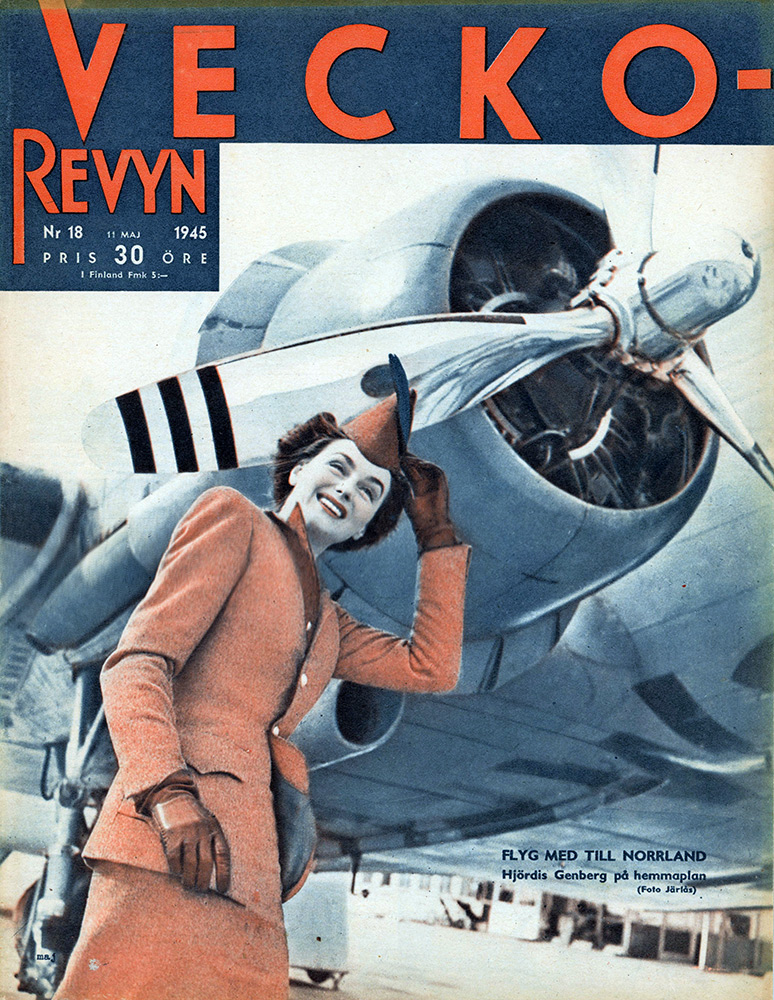
Hjördis Genberg on the cover of VeckoRevyn, 11th May 1945.

Hello everyone. What about this for a spectacular magazine cover? It’s from Sweden’s Vecko Revyn (Weekly Review), 11th May 1945, three days after the end of the Second World War in Europe. And it looks like the colour green was still in short supply.

The feature inside was really an advertorial in disguise, announcing a new DC-3 Dakota service from Stockholm to Sundsvall. Hjördis was also pictured onboard, thumbing through ABA’s inflight booklet (“Fine wines of Estonia”, “Salt, an epicure’s delight” etc). Whether she used the service in real life isn’t known!

The cover has been added to the Hjördis magazine-cover gallery.

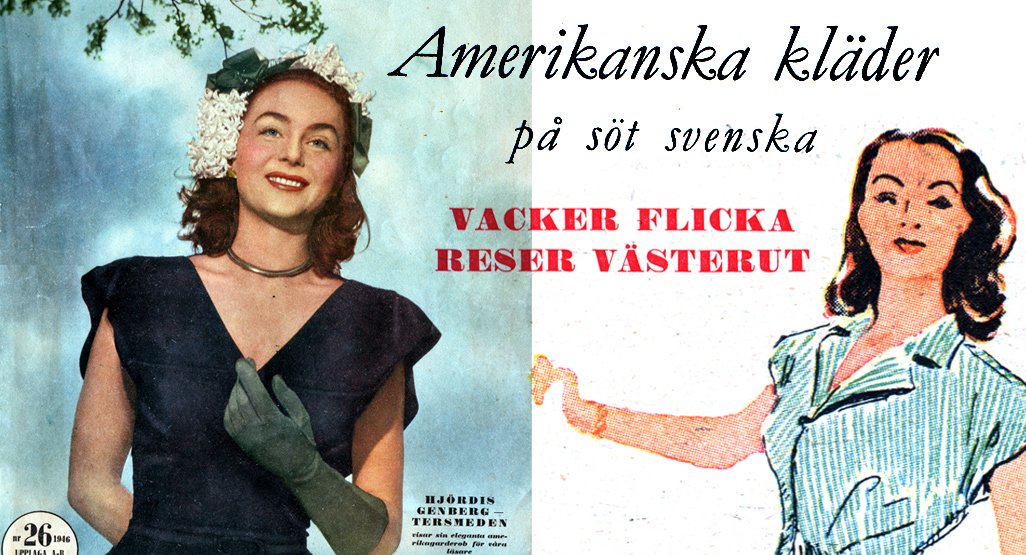
Hjördis Tersmeden modelling US fashoins. brought home to Sweden in April 1946

How to condemn thousands of women to eternal hopelessness

In 1964, Hjördis Niven related her first meeting with David Niven for UK’s Woman magazine, little expecting that 60 years later someone (hello there) would be checking the accuracy of her claims. Just for interest’s sake of course.

“David has a wonderful way of making every woman he talks to feel important and attractive. I explained that I had both designed and modelled clothes for a Swedish fashion house and also ran my own fashion page in a woman’s weekly magazine.”

Well, she did model clothes for Swedish fashion house NK Franska, very successfully. As for running her own fashion page… well, it happened once for sure, though she didn’t seem completely invested.

Newspaper teasers for the December 1945 issue of Sweden’s Vi Damer (Us ladies) magazine proclaimed: “Hjördis Genberg, Stockholm’s star mannequin no.1 teaches you the art of wearing clothes.”

The actual magazine feature looks like a one-off. Hjördis was already packing her bags to travel to the US by the time it was published. The Vi Damer staff-writer initially had trouble getting enough material to fill a paragraph, never mind an article:

“At first, Miss Genberg tried to get away with the uncomfortable explanation that the art of wearing clothes is innate. However, as that would condemn thousands of women to eternal hopelessness [a bit dramatic], she thought about it again.”

“The art of wearing clothes is the same as the art of choosing the correct clothes, we agreed. A sportswoman in ruffles is almost an abomination of nature.” etc. (The only ladies’ sport ruffles I can think of are tennis players’ frilly knickers in the 1970s)

Anyway…. where was I…. The Swedish press were still interested in Hjördis’ fashion sense on her return from the US. Her new American wardrobe contents were described and beautifully illustrated for Vårt Hem magazine: Hjördis Tersmeden : Fashion from America, 1946

The Genberg Family

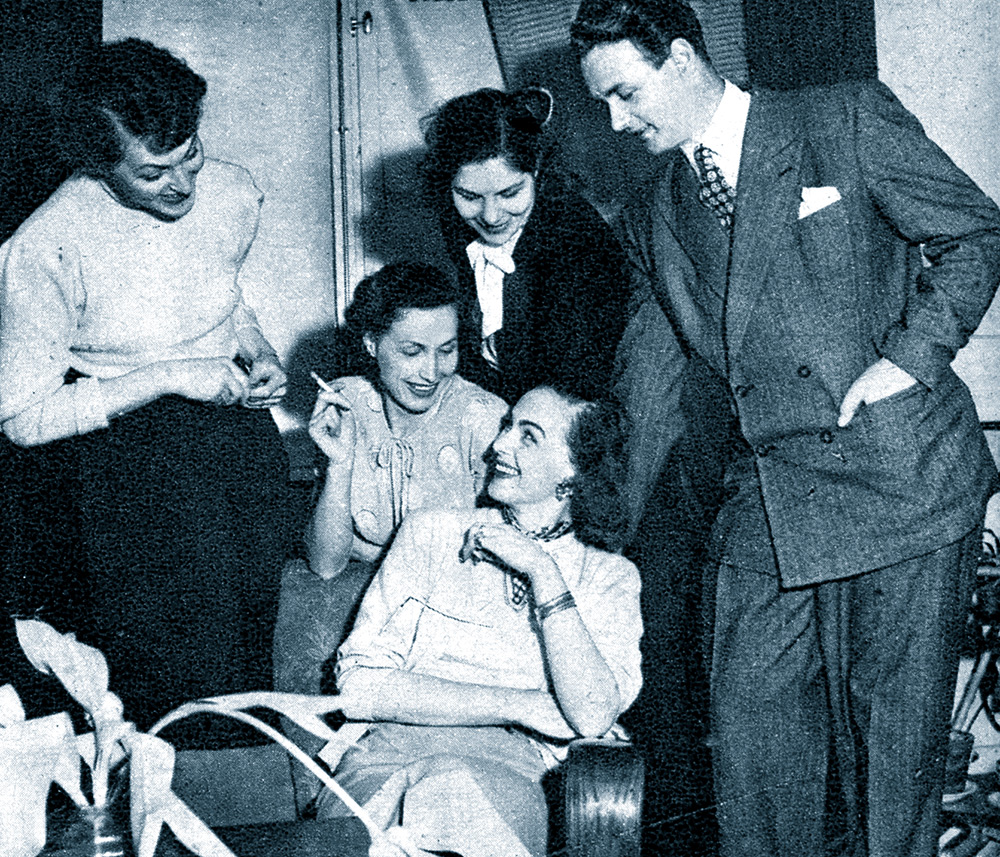
Hjördis Niven with her siblings, March 1950

In June 1947, newly-divoreed Hjördis Tersmeden left Sweden for New York to start a new life as a model, actress, and (she hoped) as Countess Cassini. She finally returned home in March 1950 as Mrs Hjördis Niven, a step-mother but not a model or an actress. Four of her five siblings gathered to meet her in Stockholm. For the full story, check out the Rocket to the stars page.

Surrounding Hjördis in the photo, from left to right: sisters Gerd Genberg, living at the time in Gothenburg, Ann-Marie Wrambeck from Enskede, Kerstin Rozén from Stockholm, and their brother Georg Genberg from Enskede… (father of the twins Gudrun and Maj-lis Genberg).

In her childhood memories, Hjördis remembered: “My siblings were remarkably beautiful, especially my brother, and the sister who was closest to me in age (Ann-Marie). She had long, thick, dark brown hair, that I was always violently jealous of, and was never as painfully thin as me.”

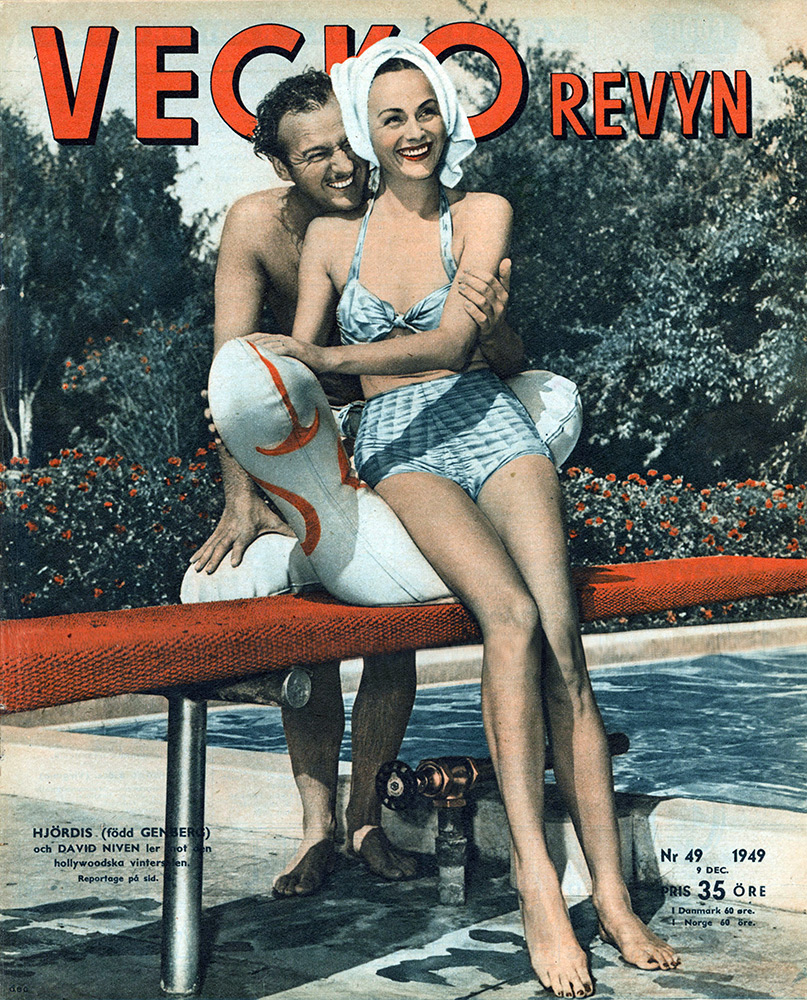
David and Hjördis Niven on the cover of VeckoRevyn magazine. Sweden, 9th December 1949.

Glacier or volcano

Speaking to an Icelandic newspaper in 1964 Hjördis recalled her lightning courtship and marriage to David Niven. “I had a husband and two sons in a few weeks. I had to move to a new country, and get used to new customs. I did not know what I was getting myself into.”

“Neither did I!” David shot back.

Perhaps inspired by the local geography, he continued:

“I thought my wife was cool as a glacier, and then suddenly she erupted like a volcano. I was so overwhelmed that I went down to the basement, locked myself in and cursed.” (The spark was the placement of a chair in the living room…)

“Yes, the poor thing,” Hjördis replied, laughing. “He was there half the day.”

A big thank you to Iceland’s newspaper archive for this and other snippets. It’s free, and it’s superb!

Art review

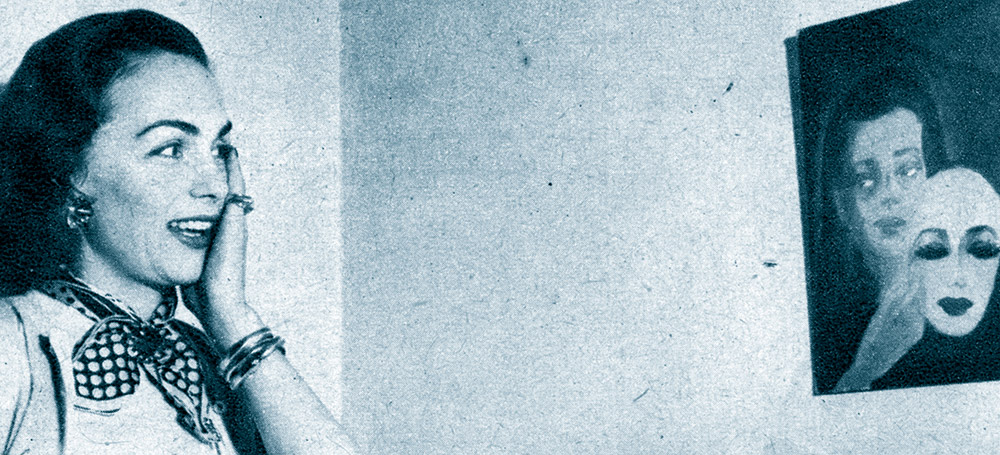
Hjördis Niven confronted by one of her old paintings, 1950

When Hjördis visited her sister Kerstin Rozén in 1950, she was mock-horrified to find one of her old paintings on display.

Her reaction? “But damn it Kerstin, why on earth do you have that horrible old thing on the wall?”

The subject matter seems obvious enough… Behind the smile, modelling can be tiring. Other interpretations welcome.

Pornographic book review

Hjordis and David Niven, 1952

(Thought you might read this section…)

In 1952. London publisher Hamish Hamilton was interested in a first English-language version of popular Swedish novel ‘Dreams of Roses and Fire’ by Fyvind Johnson. Hjördis was paid the equivalent of £60 to read and review it.

Her reaction was positive, but helped ensure that the book wasn’t published in the English-speaking world until 1984. (Way to go Hjördis).

“Oh yes. it’s a good book, and terribly pornographic, so I think you should publish it.”

Before you think Hjördis blew an opportunity to make the unexpurgated publication of ‘Lady Chatterley’s Lover’ a decade later a historical irrelevance; ‘Dreams of Roses and Fire’ was actually about a 17th century French priest who gets burnt at the stake after being accused of witchcraft. Admittedly his accuser was jealous that the padre was popular with the ladies, but, well, it depends on what you consider pornographic. That said, Hjördis had an under-appreciated sense of humour.

……

That’s all for now. Please check for site-updates on hjordisniven.com. The story is semi-regularly updated, and filled with more images when possible.

Very best wishes.

Hjördis post, March 2022

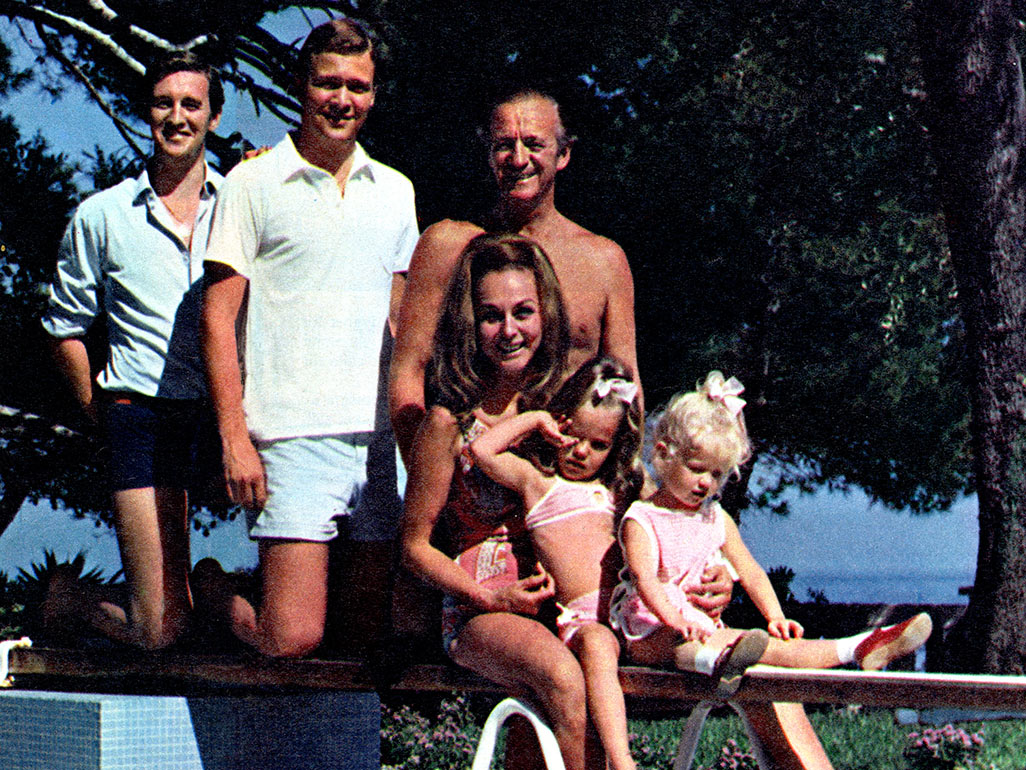
The Niven family in the sunshine at Cap Ferrat, c.1966

I hope you are all keeping well. Looking at the picture above, I think a holiday in the south of France would go down very well. However, best ignore Sam Goldwyn’s advice: “No one goes to the south of France any more. It’s too crowded.”

Photoplay

The ongoing search for Hjördis content has tripped across Lantern, an online “media history digital library”.

It’s a huge and FREE collection of movie, TV and radio-related magazines: including Variety, Photoplay, Modern Screen, Motion Picture Herald, and Screenland.

It must have been a huge undertaking to scan and it’s a fabulous source of information, although James Garner (in his Mr Grumpy guise) would not have agreed:

“I’d look at Photoplay and think, What a bunch of phonies! All those supposedly candid shots of the stars in ‘real life’. You could see them posing. I never understood the whole fan thing, because I’ve never been a fan of anybody. I didn’t want to be part of that. But… I did those same stories, to my shame. The fan magazines were so sleazy, they weren’t saved in libraries like old issues of Life or The Saturday Evening Post. I’m glad.”

But they’ve ended up on Lantern, accessable for everyone. So there.

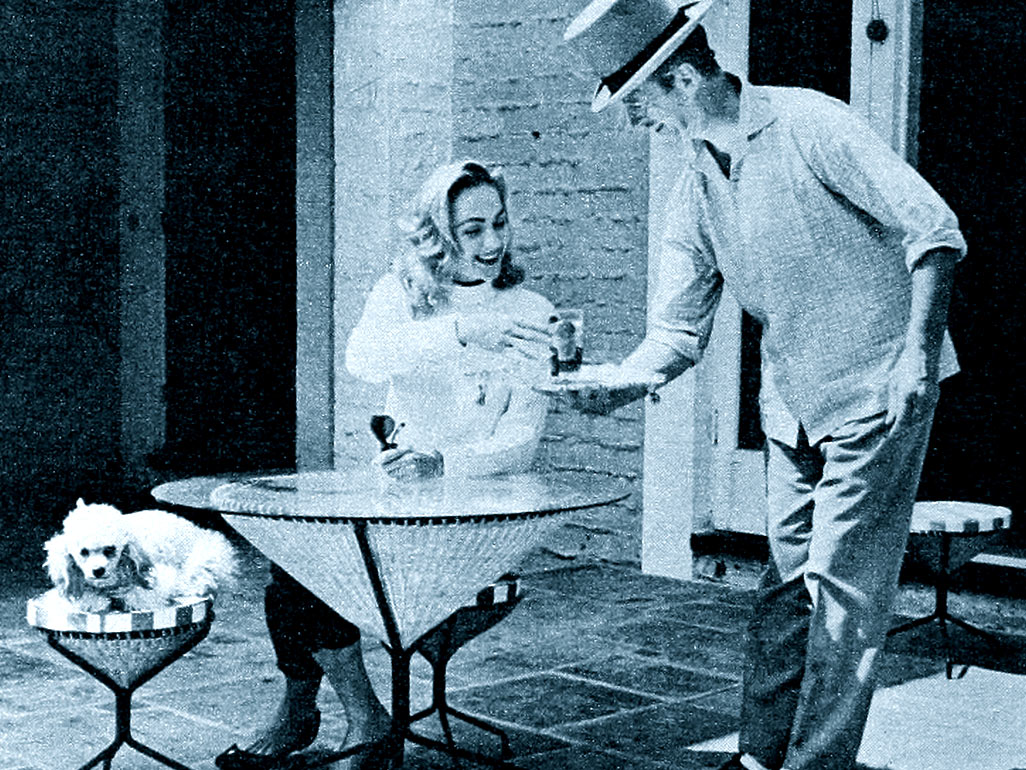
Photoplay, 1957. Top-hatted David serves Hjördis on the Pink House patio. The image is posed, but similar things did happen in real life when was trying to cheer her up.

Regarding Hjördis, the magazines are a decent source of images. The text is less interesting but does contain a few nuggets.

The main events covered are her wedding to David in 1948, and their temporary split in 1959. The latter is a mix of contradictory theories, patched together alongside old interviews and publicity bios.

Gossip queen Louella Parsons wrote for Modern Screen that part of the distance in the Nivens’ relationship was caused by Hjördis’ full-on social life. New to me!

“Hjördis appeared to love the social side of Hollywood and also busied herself with committees outside of pictures working on charity affairs [affairs, huh?]. These activities took a great deal of her time – not that David really objected. Because of his wearying schedules, David frequently bowed out of party engagements to get to bed early.”

On the other hand:

A ‘close friend’ was quoted as saying: “I’ve seen this rift widening between the Nivens for some time. Hjördis hasn’t been well lately, and she’s been leading too solitary a life, whether by choice or not. David, a gregarious soul, has been so busy with other projects that he hasn’t been able to devote himself to her as he did some years ago.”

Hjördis at the digital museum

Nordiska Kompaniet’s dress designer Pelle Lundgren with Hjördis Niven during a visit to her old workplace in 1953. Photo: Glase, Gösta / Nordiska Museet (CC BY 4.0)

In her pre-Tersmeden and Niven days, Hjördis Genberg was top model at the Franska (French) department in Stockholm’s prestigious Nordiska Kompaniet store.

Thousands of NK’s fashion photos are in the process of being scanned and uploaded to the Swedish digital museum at https://digitaltmuseum.se.

If you are interested in social history, fashion in particular, it’s an absolute treasure-trove. All free to view, and free to reproduce with a Creative Commons credit. There are over 100 images of Hjördis taken between 1941-1945.

Paris of the North (NK’s French Couture Atelier 1902–1966)

Nordiska museum’s “Paris of the North” exhibition.

The Nordiska museum in Stockholm currently has an exhibition of NK Franska’s vintage fashion photos and garments, running until 18th September 2022. Real, not virtual!

For more details: https://www.nordiskamuseet.se/en/utstallningar/paris-north. I wouldn’t know one dress from another, but it does look amazing.

There is also an accompanying (Swedish-language) book, titled “Nordens Paris” by Susanna Strömquist. Hjördis is mentioned briefly, and there are photos of her in both the book and the exhibition.

For international shipping, Susanna recommends konstigbooks.com, specialists in art, design and photography books.

And… I think that’s all for now! hjordisniven.com is still being regularly updated, so please do visit.

Best wishes for now.

Hjördis Niven. Christmas post 2021

(Is it Christmas already??)

Hjordis Niven and family, 1969
The Nivens in Switzerland in the late sixties.

I hope you are all keeping well. There is plenty of new material to share on hjordisniven.com in the coming weeks. I’ll preview some in this post.

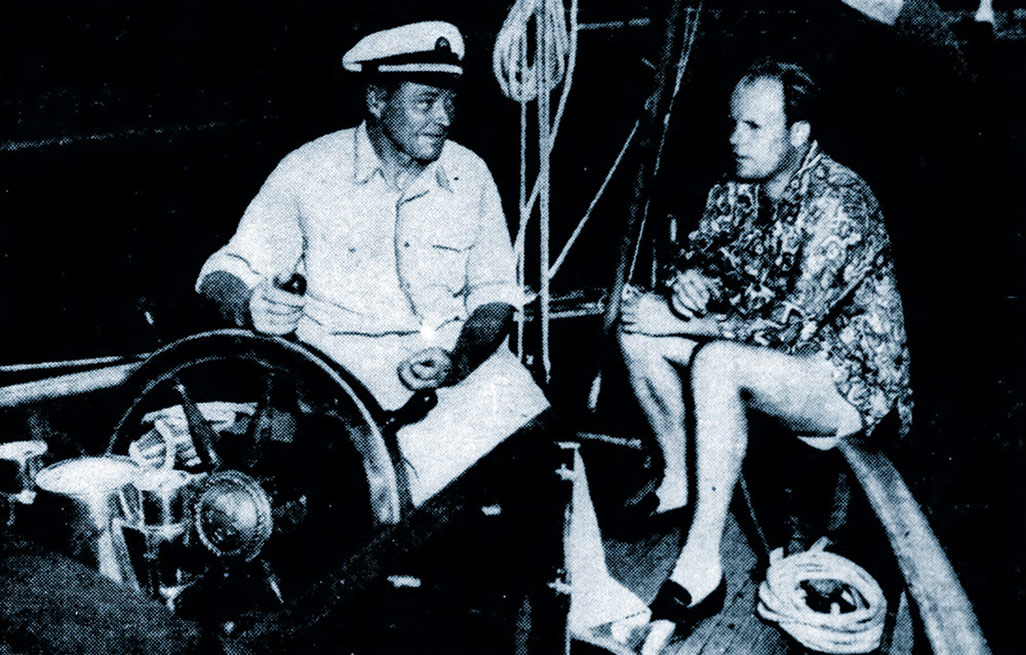
Yachting with Hjördis’ first husband, Carl-Gustaf Tersmeden

Colonel von Schinken, air attache of the Swedish embassies in the US and Canada, sailing with Carl-Gustaf Tersemeden, August 1949.

In 1949, several years before Carl-Gustaf was skewered in the US press as a “stout Swedish socialite” he was gushed over in Newsday as a (deep breath) :

“Dashing young Swedish paper pulp merchant prince temporarily at liberty after shedding his second wife Hgordes Jenberg,” [which sounds like someone trying to say Hjördis Genberg after testing David Niven’s Christmas Glögg recipe] under the headline “Debutantes’ hearts flutter over wealthy viking yachting off Long Island.”

Carl-Gustaf had his 60 ft yacht ‘Symfoni’ transported across the Atlantic on an American freighter, and spent his summer sailing the US north-east coast. Later in the year Igor Cassini unashamedly reported C-G ‘s arrival in Palm Beach to chase the ladies.

After his divorce from Hjördis, Carl-Gustaf spent six months a year in the US, selling wood pulp to US newspaper publishers. Ironically, some of it was used to tattle on his playboy lifetsyle, and ultimately just to call him fat and sad. There must have been some degree of jealousy.

Hjördis gets noticed, part one

David and Hjördis Niven, 1958

One often repeated statement about Hjördis’ marriage to David Niven is that she was often upset about not being noticed when she was with him.

“When a beautiful woman walks into a room she should immediately get the attention that is her prerogative,” David explained. “If she is alongside someone whose face happens to be well-known she can get pushed aside.”

But, occasionally the reverse was true. This snippet coms from the London Evening Standard in May 1950:

“A photographer recognised Mrs. David Niven in the stalls at the Vaudeville last night. After he had taken her picture he wrote down her name, turned to her husband who was with her and asked ‘And what is your name, please?’

Niven said: ‘It’s still me.'”

Hjördis gets noticed, part two

The Nivens around-the-world holiday in 1958 has been used as a prime example of Hjördis’ irritation about David drawing attention, which he admitted was a source of pride:

“After 25 years in Hollywood movies, I found it impossible to walk unrecognised down back streets of Bangkok or Calcutta. In Istanbul, thinking we could spend a quiet afternoon at a soccer game, we were spotted, rated a loudspeaker announcement, applause and autograph seekers. My head was high and my chest out until early the next morning.”

The next morning was a rare win for Hjördis. She repeated the story more than once, but this was David’s take:

“We had a blowout on the way to the airport and the taxi had no spare. So there we were miles from anywhere at 7am.”

“Then came an army to rescue. A convoy of trucks appeared, and a jeep disengaged itself to offer assistance. Hjördis, who was wearing a bright red Chinese dress complete with a slit up the side, was snuggled in beside the colonel. I was unceremoniously stuffed into the cook’s truck with all the baggage.”

“On arrival at the airport there was much (really too much) kissing of Hjördis’ hand by the officers while I was instructed to unload our baggage. The came the final blow – Hjördis was asked for HER autograph! Oh well!”

And finally, talking of autographs

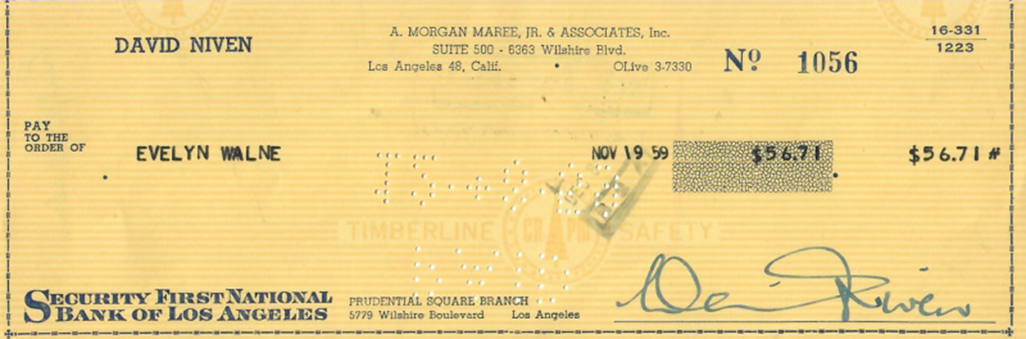
Cheque written by David Niven to his children’s nanny Evelyn Walne. November 1959. https://www.memorabilia-uk.co.uk/p/david-niven

The best way to land a genuine David Niven autograph these days is through the sale of his used cheques. Although David’s examples are usually cashed, including one made out to Hjördis “for house-keeping”, cheque-writing could be profitably used by celebrities.

In ‘The Garner Files: A Memoir’, James Garner mentioned that: “Gary Cooper wrote checks for everything – gasoline, cigarettes, groceries, meals in restaurants – because he knew most of them wouldn’t be cashed. Coop figured he might as well get paid for signing his name.” Clever.

The day after David and Hjordis’ wedding reception in London, a hopeful attempt to land autographs went sadly wrong:

“A telegraph boy crossed the road in Buckingham Place last night, and rang the bell at the house where David Niven was holding his wedding reception.”

“To a manservant who opened the door the boy presented a sheet of paper. It came from the typists looking on from near-by windows. They hoped Mr.Niven and his guests would fill the sheet with autographs.”

“It back it came with one signature – the manservant’s. Apparently he thought he was signing a receipt for a telegram.” Way too subtle.

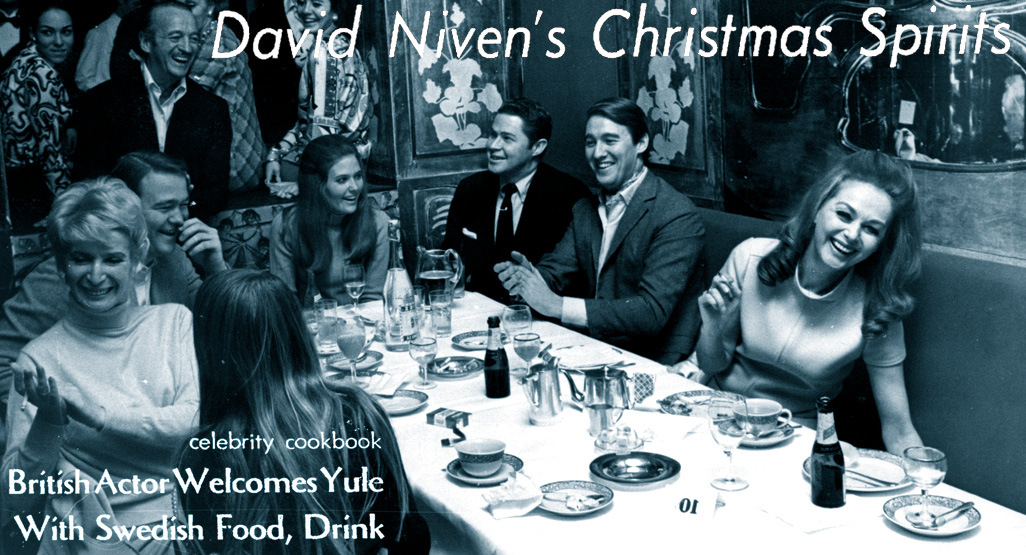
As ever, I’ll round this post off with the Nivens’ favourite Swedish recipes, including a Christmas drink that sounds like the sort of concotion usually put-together in prison radiators: David and Hjördis Niven’s Christmas recipes, 1967

HjordisNiven.com, August 2021

It’s been a while since the last post., so there is some catching up to do. I hope you are all keeping well, and that life is getting back to normal.

Gudrun Genberg

First of all is the sad news of the death of Hjördis’ niece Gudrun Genberg, also known as Pia Genberg. Gudrun passed away in 2020. The page about her and twin Maj-iis’ eventful careers as models, dancers, and actresses has been updated: Pia and Mia Genberg.

Pia and Mia Genberg in Las Vegas, 1960
A beautiful still from the 1960 movie “Pepe”, with Maurice Chevalier flanked by Gudrun and Maj-lis Genberg.

Crofting in Röksta

More photos and information have been added to the story of Hjördis’ early years, when her father worked as a crofter in the northern half of Sweden. The family’s house was demolished as early as the 1940s, with even the foundations repurposed. The site has been tracked down and photographed by local Röksta historians and kindly sent by Hans Jonsson: Long winter evenings in the north, 1919-1929.

A small wall at the site of the Genberg family's croft in Rismyra,.
A small wall at the site of the Genberg family’s croft in Rismyra,. Photo: Hans Jonsson.

Rocket to the stars

In early 1950, Hjördis and David Niven were visited at their home in Pacific Palisades for a newby television cameras for a new half-hour series / elongated series of Oldsmobile adverts called ‘Rocket to the Stars’.

Not only has the programme survived, but it can be viewed on YouTube, in excellent quality. Hjördis is shown young, beautiful and charming, as well as excited and very nervous. David is, of course, entirely at ease throughout.

Book corner

Next, a book recommendation: ‘In My Own Fashion’ by Oleg Cassini. Oleg became a leading fashion designer, married movie star Gene Tierney, and was of course Igor Cassini’s brother. (Igor lured Hjördis away from her first marriage).

David pops up a couple of times, with a very direct assessment of his friendship with Errol Flynn, and a heartbreaking description of the party at which Primula Niven met with her tragic accident. ( Primmie Niven, 1918-1946 )

Hjördis is not directly mentioned in the book. Many people and places connected with her life and times in Hollywood are described, and with absolute candour. Oleg observations about life as an outsider in Hollywood add a lot colour to this website.

And finally, for now, a German edition of David’s second best-seller: ‘Bring on the Empty Horses‘, retitled ‘Stars : That Did Not Fall From The sky’.

Hjördis was not a fan of the book. The verdict was: “That’s another pack of lies”, so it’s ironic that a happily smiling Hjördis is displayed on the cover. (The photo looks like it comes from one of Princess Grace’s evening events in Monte Carlo).

Hjördis and David Niven on a German book cover, 1977
Hjördis Niven featured on the cover of the 1977 German edition of ‘Bring On The Empty Horses].

For other book reviews, check out the The Hjördis Niven bookshelf.

Hjördis updates, 2020

Page views on https://hjordisniven.com are reflecting that more and more people are at home and online during these strange and stressful days. I hope you are all safe and well.

A couple of years ago I thought that the story of Hjördis’ life was as complete as it was ever going to be. However, information just keeps on showing up, revealing all sorts of new paths to explore.

The first pages of the story…

Salsåker school, 2020

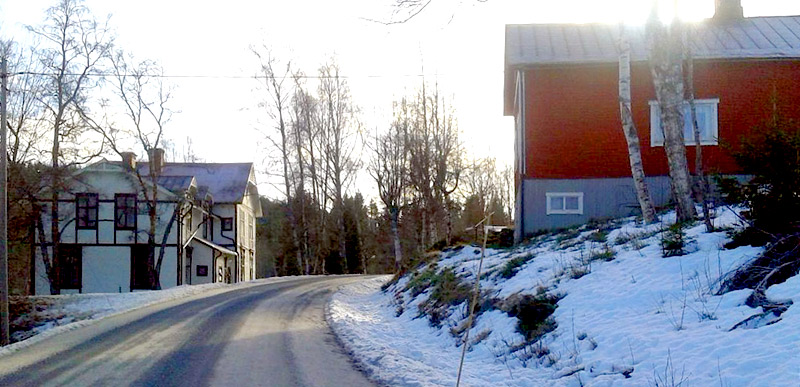
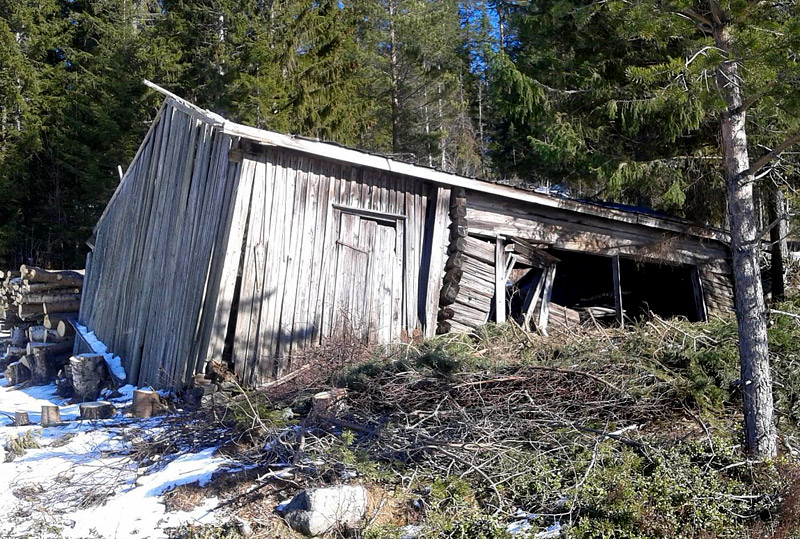
Hans Jonsson has kindly photographed the two school buildings in Salsåker that Hjördis attended before her family moved to Vivstavarv in 1931. The red building on the right catered for the 7-8 year olds. Older children were taught across the road to the timber framed building. It’s quite a surprise that both are still standing…  and it’s downright amazing that the old smithy that used to terrify young Hjördis is also (just about) standing. Though I wouldn’t lean against it.

Sadly the Genbergs’ house in nearby Röksta no longer exists, and may have been pulled down as early as the 1940s.

[Daniel Spencer has commented that hjordisniven.com is becoming more of a graphic novel than a blog. If it’s heading that way… well, great!]

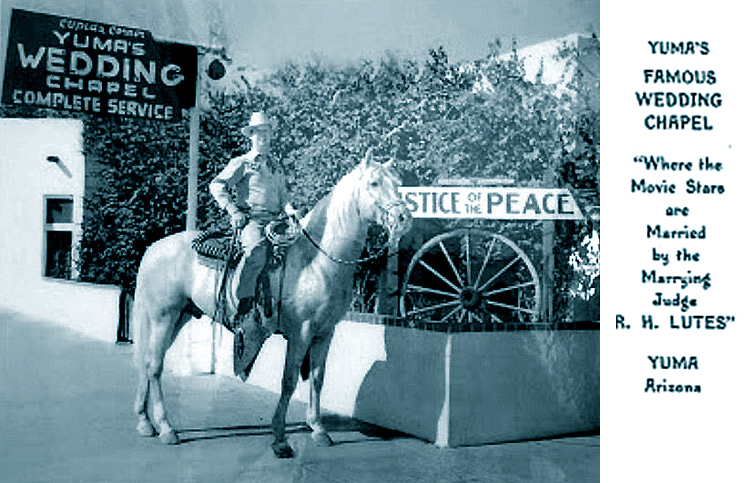
Moving on to the Genberg-Tersmeden year and a half, details have surfaced about Hjördis’ first marriage, to Carl Gustaf Tersmeden. Hjördis caused  confusion by claiming in 1960 that the wedding took place in Azusa, California. Not so.  The venue was actually Judge RH Lutes’ in-and-out-no-fuss Wedding Chapel, in Yuma, Arizona. Although only a small border town famous for growing winter lettuce, Yuma also became the fashionable venue for Californian stars who didn’t want to wait for their state’s statutory blood test before being granted a license.

R.H.Lutes

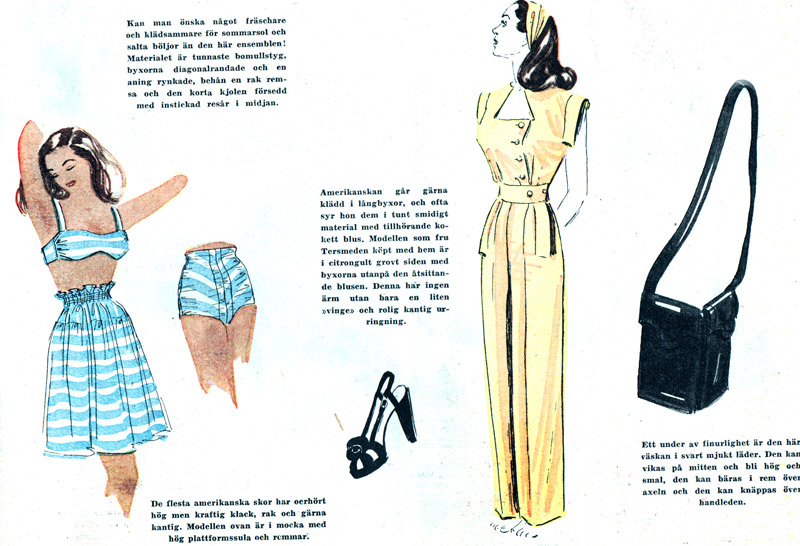
When Hjördis arrived home in March 1946, the American fashions that she brought back were of such interest that her new wardrobe was described and illustrated across three pages for Swedish magazine Vårt Hem.

Our website attracts a lot of people most interested in Hjördis because of her modelling days, and the fashions that she was pictured in, so this new page is for them, and also serves as a snapshot of  US fashion (for the well-heeled) between December 1945 and March 1946.

 The last pages of the story…

Much slower to turn up are details of Hjördis’ lost years of alcoholism following David Niven’s death, and her eventual recovery. But there is some new information that helps to tie it all together.

All site updates can be found on the site map page.

Very best wishes for now.

May 2019 at hjordisniven.com

Regarding recent updates to hjordisniven.com – well, there are plenty of new details and images, mostly in pages covering the 1930s and 1940s.

This includes new information about Hjordis’ marriage to Carl Gustaf Tersmeden, revealing similarities with her second marriage: about how her husband behaved, and how she reacted. There are plenty of tangents, such as the photo below from Carl Gustaf’s first (short) marriage, to Ingegerd Beck-Friis. Is that a look of doubt on his face, or just a look of doubt on his face…

Carl Gustaf Tersmeden with his first wife on their wedding day.

There is also a new page, concerning Hjordis’ first year as a model, illustrating her astonishingly rapid ascent from nervous would-be modelling student in 1941, to undisputed Queen of Leja in 1942. From mid 1942 until her move on to NK Franska in late 1943 she was the one and only model to feature in Leja’s advertising. Remarkable. (The image below is from May 1942).

Hjördis Genberg, Leja's top model at work in May 1942

Check out the site-map and updates page for other new additions.

Elsewhere, David and Hjordis Niven’s chalet in Chateau D’Oex came up for sale in 2018, for only the second time since Hjordis’ passing. There are a variety of excellent photos of both the exterior and interior. Hjordis’ niece Anette notes that the chalet has been renovated and looks better from when it belonged to her uncle and aunt. Happily, David’s matador paintings in the cellar are still there, as bright and colourful as ever…

The cellar in 2018, with David's paintings still bright and vivid.

And finally, while Hjordis was still residing in the chalet, I wonder if she knew that she was on a indie band’s record sleeve? In 1991, Swedish band Happy Dead Men released vinyl single “Science Fiction”, sporting a 1945 photo of Hjordis on the front cover…

As ever, your comments and contributions are welcome!


Hjördis Niven. Christmas post 2018

Hjördis Genberg, modelling Swedish fashions in 1944
Hjördis Genberg, modelling Swedish fashions in 1944. Photo: Holmén, Erik, Nordiska museets arkiv.

Hej!

Well, there has been a brief hiatus on hjordisniven.com, mostly due to my own family matters. However, I am back revisiting Hjördis’ world, and on the look-out for new information about [cliche alert] her life and times.

Recent updates include two slightly tangential pages. Modelling in Sweden focuses more on Hjördis’ fellow mannequin Kim Söderlund, who used her experience to overhaul the profession from the 1950s. You’ve heard of “Twiggy”, well Kim was “The Plank”.

Swedish fashion in the 1940s is really an extension of the Life in wartime Sweden page. Hjördis worked for the Nordiska Kompaniet’s ‘Franska’ (French) department from 1943-1945, and although she didn’t work in occupied France, there was at least one Swedish correspondent in Paris, sending heavily censored fashion news back to Stockholm. Swedish designers also produced their own designs, viewed in the US with some bewilderment:

“Sweden’s fashions styled during the war are middle-road in design, stressing neither American casualness, French sophistication, nor British utilitarianism.” Well, there was a war on…

Miss Hammarström and Miss Hjördis Genberg, modelling in 1944. Photo: Holmén, Erik, Nordiska museets arkiv.

The poison pen

Elsewhere, there are updates about Hjördis’ first marriage, to the Swedish millionaire playboy Carl-Gustaf Tersmeden. These include how Igor Cassini used his society gossip column in efforts to break the marriage, starting with a gratuitous piece about Hjördis on 12th February 1947, written after spying her at a party in Miami:

“Mrs Tersmeden is vivid, many-ringed and rather beautiful and used to be a model in Stockholm. When Mr Tersmeden came over here last year on business she followed him to Tucson, Arizona, pounced on him from behind a cactus and married him, not too much against his will, I gathered.”

This lead on to Hjördis being written about for having the best figure on the beach, and a mere two months later being listed as a Swedish celebrity alongside Greta Garbo and Ingrid Bergman.

As for Carl, not only were his post-Hjordis dalliances listed by Igor, but also by other columnists, and with a slight jab of of poison:

“Carl Tersmeden, the blonde portly man-about-town may wander along Gold Coast smart spots with various and sundry good looking gals, but he’ll never find one as lovely as his ex-wife, the former Hjördis Tersmeden, who is now married to David Niven. Carl knows it too.”

Hjordis Genberg, 1945
Hjordis Genberg modelling for NK Franska, 1945. Photo: Ateljé Uggla AB

Anyway… Christmas!

Mind you, Carl Gustaf’s 1945 Miami Christmas with Hjordis was not the easiest, as she revealed in 1947:

“Christmas Day came. Warm sunshine instead of snow. It was not like home. My heart grew so heavy. I cried all day. I did not care for palm trees, flowers and hot sun on Christmas Day. I longed for the clean white snow, the brisk invigorating air, the sleigh bells, the church bells of Sweden. To comfort me, my husband bought me a little fir-tree, I don’t know where he got it but it did help some.”

What they also needed was some Swedish Julglögg. Twenty years later, David Niven generously shared the recipe to spice up  (or blow up) everyone’s Christmas. And here it is again: David and Hjordis Niven’s Christmas recipes.

Happy Christmas everyone, and the best of luck for 2019!