
OK, I’m going to fast forward the story, but just for a few paragraphs…
One of the biggest myths about Hjördis is that she was a failed actress, which led to decades of alcohol-fuelled jealousy aimed at David Niven, her loving husband, who had done nothing but protect her from her lack of ability.
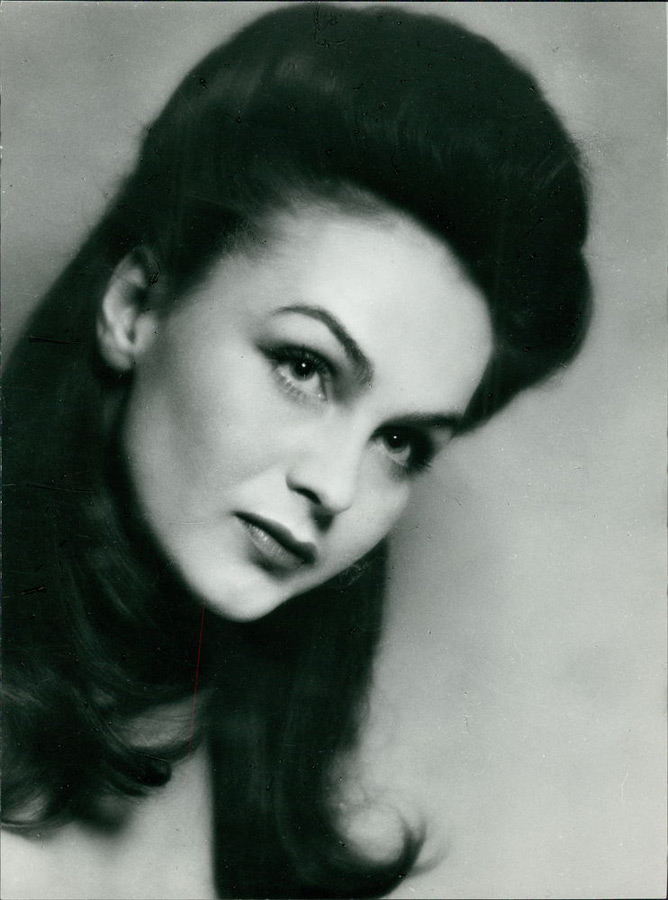
“She was fantastically beautiful but utterly devoid of talent, so she never became the actress she wanted to be.”
That was how journalist Ann Leslie understood the situation after years of interviews with David. It’s more accurate to say that no one knew how much latent talent Hjördis possessed and that she was never allowed to find out, despite being teased with movie offers throughout the 1940s and 50s.
The myth was set in stone by David Niven’s biographer Graham Lord, who (weirdly) theorised that David forbade Hjördis from accepting movie offers out of the goodness of his heart:
“Maybe he already knew she was a terrible actress and was trying to save her from embarrassment and failure.”
Wrong. David had never seen Hjördis act. In Graham Lord’s defence, he was probably unaware that, before marrying Hjördis in 1948, David laid down the law that he did not want her to have any sort of career, ever. In addition, I’d say he was unaware that Hjördis had already walked into the same situation in 1945.
A dedicated wife
Film work opened up very slightly for Hjördis in 1943, when she made two uncredited appearances in Swedish movies. In February, she enhanced two brief nightclub scenes in ‘Fångad av en röst’ (‘Captured by a Voice’), and in June / July, she appeared as a woman playing roulette in ‘Sjätte skottet’ (‘The Sixth Shot’). Although set in Monte Carlo, the scene had to be filmed in Stockholm.
Hjördis’ blink-and-you’ll-miss-them background scenes in ‘Fångad av en röst’, both set in the Carlton Hotel, Stockholm. She’s chatting at the bottom-left in the first clip and dances past the principal actors in the second. Maybe she was more visible on the cinema screen than this 4×3 television cut.
Hjördis’ brief scene in ‘Sjätte Skottet’. In later years, she would become familiar with the interior of the real casino at Monte Carlo. The young woman that the camera pans across just before Hjördis looks like her friend and fellow NK model, Kim Andersson.
As you can see, Hjördis was a decorative extra rather than a budding actress. The 1943 movies probably came through an arrangement with Leja to provide beautiful extras.
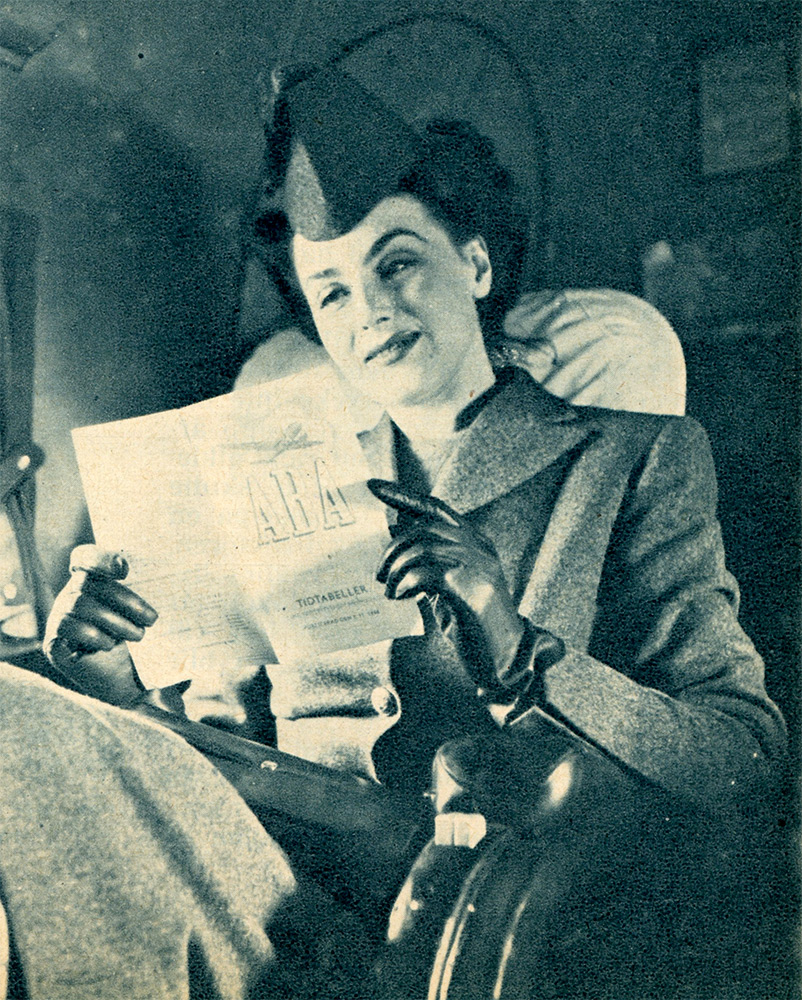
More prominent roles did not follow. Around this time, Hjördis moved from Leja to NK Franska, and her modelling career hit new heights. By the start of 1945, she was at the top of her profession, engaged to one of Sweden’s wealthiest men, and half of a celebrity couple gushed over in the press.
“Miss Hjördis Genberg, one of Stockholm’s most famous fashion models,” one newspaper enthused in January 1945, “has become engaged to Lieutenant Carl Gustaf Tersmeden. Lieutenant Tersmeden is a well-known sailor and owner of the large yacht Symfoni.” [Getting the name of your yacht in an engagement announcement. Go Carl Gustaf.]
By the way, ‘Symfoni’ was built for the Crown Prince of Sweden in 1937, illustrating the depth of Carl’s pockets.
“With me, when things are going well, they go very well,” Hjördis later wrote, “and when they’re bad, it’s one disaster after another. I found myself at a peak period of my life, but I was still completely stunned when Mrs Pauline Brunius, then head of the Royal Dramatic Theatre, called me and asked for a meeting.”

“When I went to her, she asked if I had ever considered becoming an actress. She and some other board members had noticed me and found my type and appearance unusually suitable for the profession.”
“In a few months, the entrance examinations for the student school would take place, and they thought they would give me a chance. Of course, I was overwhelmed by this and said that I would like nothing better. However, I lacked the financial means to afford such training if I passed the entrance examination.” (Odd thing for the fiancée of one of Sweden’s wealthiest men to say, so you’d think…)
“Then she told me that they had already discussed the matter and, first of all, one of the board members was willing to help me financially during my study time, and secondly, they were willing to make an exception in my case. I would be given small roles as soon as I was ready. She even had a manuscript for me and saw a teacher who would help me study for the role. As I said, I was completely overwhelmed. I did not know how to answer, but asked for a short reflection time. One thing I did know, this was the biggest compliment I’d ever had!”
Scholarships from the Royal Dramatic Theatre had previously helped Greta Garbo and Ingrid Bergman in their acting careers.

“This was a huge decision for me. There was only one thing I could do: discuss the matter with Tersan.”
“He understood my views, understood how excited and grateful I was over the offer, and understood that in every person, even a young girl who is a leading model and engaged to an appropriate young man [Captain Modest], whom she also loves, there is a desire to do something with her life. I mean something big and demanding, something that, of course, can fail but also lead to success and a career. All of this he understood.” [Here comes the “but”…]”But there was also something he wanted me to understand. We loved each other and were engaged to be married. He did not want a wife who spent most of her life on her career. He wanted a wife dedicated to him.”[A BIG mistake there, C G…]
Leaving the country
In 1955, Hollywood gossip columnist Louella Parsons reported that Hjördis had studied dramatics but never used her training. This suggests that Hjördis may have taken her first steps towards an acting career before Carl Gustaf brought it to a halt.

As for her never putting her training to use – maybe not entirely. By coincidence or not, three more movie bit parts arrived in 1945. On 8th May, the day the Second World War ended in Europe, filming commenced on ’13 Stolar’ (’13 Chairs’), in which Hjördis appeared, suitably, as an NK model.
The movie only seems to have survived in truncated form, which would explain why it isn’t available on DVD.
According to the IMDB: “About 20 minutes from various parts of the film seem to be forever lost, as they were edited out for the compilation ‘Åke klarar biffen’ (1952),” [aha, so there is hope!] “which is lost too.” [Aw, nuts.]
The story involves the frantic search for money hidden in the upholstery of one of thirteen chairs. One of the chairs is at a fashion house, which I guess is where Hjördis, NK, and NK’s dresses come in.
The other NK models in the promotional photo are Margareta Berglund (in the white dress) and Margareta ‘Marjo’ Bergman (sitting in the patterned dress). Their working lives showed that, at least in Sweden, marriage did not necessarily mean an abrupt end to models’ careers.
Margareta Berglund married in 1946 and, as Margareta Nordlund, continued to travel as a star model for NK right through to 1959, when she was 40.

Marjo Bergman was one of six students accepted into the Royal Dramatic Theatre’s acting school, ‘Dramatens Elevskola,’ in September 1945, possibly benefiting from Hjördis’s inability to take her place. Marjo landed a supporting role in the 1946 movie ‘Barbacka’, and despite marriage and children, continued to act in Stockholm theatre productions.
Of the three other female Dramatens Elevskola students in the 1945 intake, Marit Bergson landed roles in Swedish movies and theatre between 1948 and 1950 before marrying movie and theatre director Göran Gentele. Tragically, Göran Gentele and the couple’s two daughters died in a car crash in 1972. (As of March 2024, Marit Bergson is still with us, now in her late 90s.)
Marianne Lindberg acted at the Royal Dramatic Theatre for eleven years. She was apparently the only one from the class of 1945 to graduate in 1948. In 1961, she married Swedish prince, Sigvard Bernadotte. Ulrika Modin also had a lengthy theatre career, working with Ingmar Bergman.
Hjördis’ sights may have been set further from home: “I couldn’t wait to leave Sweden.”
Over and out

In the remaining months of 1945, Hjördis made two film appearances. She modelled clothes for a short documentary called ‘Tidningar! Tidningar!’ (‘Newspapers! Newspapers!) created to celebrate 300 years of the Swedish press. It was shot in August and premiered in February 1947.
A final (uncredited) movie appearance followed in September, with Hjördis playing an officer’s wife in ‘Brita i grosshandlarhuset’ (‘Brita in the Merchant’s House’ or ‘The Maid’).
Her appearance lasted for around three seconds, swooping into a chauffeured car outside her workplace, the NK store in Stockholm. I guess she was listed as an officer’s wife because she was about to become one in real life. There is no sign of an officer in the scene. Anyway, if you have a few spare seconds, here it is…
The story would have had some resonance with Hjördis. In short, Brita is the daughter of a poor crofter who arrives in Stockholm by train, clutching her suitcase, is awed by the sight of NK, and then sets off to report for work as a maid at the home of a wealthy businessman living on the Strandvägen. (Where Hjördis actually lived). She falls for the son of the house, but can they bridge the social divide?… Etcetera.
Filming on ‘Brita i grosshandlarhuset’ was completed on 28th November, but Hjördis was not in Sweden for its premiere in February 1946.
“And so it was. I refrained from a possible career as an actress, and we started making plans for the future. It was decided that Carl Gustaf would travel to South America and that I would come over later and meet him in the US. “
In the first week of November, Hjördis applied for a visa to travel to the US and booked to sail in December.
“He left, and two months later, for the first time in my life, I left the country of my birth.” She also left her hugely successful modelling career.
Next page: Mrs Hjördis Tersmeden
…Or you can explore a couple of background pages first to look at life in Wartime Sweden 1939-1945, then take a quiet stroll through a gallery of Hjördis Genberg’s 1945 fashion photos


I do think Hjordis’supposed acting ambititions are a red herring -she wanted to be a fashion designer….Presumably why she flirted with Igor Cassini whose brother was a well connected designer. (You mention Igor was tarred and feathered by an angry mob- curious that Sir Harry Oakes was similarly treated during the infamous murder under the Duke of Windsor’s nose).
LikeLike