
The girl labelled as one of the world’s most beautiful women, Sweden’s first supermodel and Sweden’s Cinderella, was born Hjördis Paulina Genberg on 10th November 1919.
Hjördis was the fourth of six children (five girls and one boy) to Gerda Paulina (née Hägglund) and Johan Georg Genberg. Her father was a sågverksarbetare (sawmill worker). This profession was later used as ammunition by at least one character [not David Niven] who viewed himself as her irreconcilable superior. It left a mental scar, I don’t want to say a chip on the shoulder, that made her prone to adding flashes of fantasy to her background. We’ll get a couple of those out of the way before dipping into the facts:
1. “Pappa came from a Walloon family (Belgian émigrés),” Hjördis claimed, starting her story with a touch of the exotic, “and my mother was Swedish, though I always thought she had some gipsy in her.”
Two of her family have had their DNA checked and found they are 100% Scandinavian. Not a Walloon in sight. Oh well. Never mind. The idea may come from Hjördis’ first husband’s Dutch grandfather, who became one of Sweden’s wealthiest men.
2. “On a cold, dark November day just before I was born, my mother heard Hjördis Schymberg sing in concert. She was so taken by her song that if her baby was a girl, she would be named Hjördis.”
A lovely story and probably a load of old crap. The (pre-fame) Swedish singer Hjördis Schymberg was only ten years old. That said, she was already performing with her older sisters in the Sundsvall area, where Hjördis’ mother originated.
Röksta lifestyle
Hjördis’ birthplace was the tiny village of Åsarne in Jämtland county, a region of lakes, trees and sawmills in the northern half of Sweden. Her often repeated birthplace (not by her) of Kiruna (Sweden’s northernmost city, more than 500 miles further north) is an arctic exaggeration.
It could be related to David Niven’s spiced-up Hollywood publicity bio, which erroneously listed his birthplace as Kirriemuir, Scotland.
Life for the growing family was rarely settled, probably due to Johan Genberg having to move wherever there was work. They only set up home in Åsarne in 1917, and by October 1920, were on the move again, eastwards to another forested outpost, Röksta, in the Nordingrå parish.
To feed his family, Johan maintained a small croft near the sawmill where he worked and became a full-time torpare (crofter) when his teenage son Kalle was old enough to replace him at the mill.
Hjördis only gave away snippets about her earliest days, although, in 1950, she looked back at the poverty level: “I’ve come a long way from my poor childhood home, with its six hungry brothers and sisters.” An Icelandic newspaper later reported that as a small child, Hjördis dreamed of marrying a baker so that she and her family would have enough to eat.
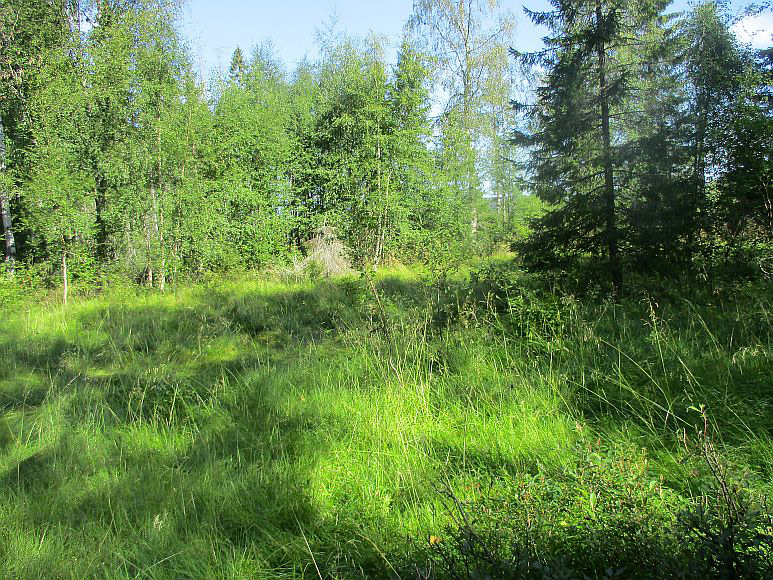
The Genbergs’ house in Röksta no longer exists and may have been pulled down as early as the 1940s, which doesn’t say much about it. In 2021, all that remained were a few ditches, a small wall, and some open spaces that may have been fields or meadows. The house’s foundations were probably recycled.
The Genberg children attended school in nearby Salsåker. The photo below is one of the more unexpected finds for this website: 7-year-old Hjördis’ class in 1927. Hjördis is the straight-backed girl, standing fifth from the right. Her teacher, Mrs Sigrid Berglund, is standing at the back. Thanks to Eileen Hedstrom for locating the photo.

“The class was called Småskolan,” local historian Hans Jonsson explains, “an old name for the first two years of school in Sweden. One of the girls in Hjördis’ class, Mary Grafström, later sent the picture to the local daily newspaper Västernorrlands Allehanda. It was published on 27th January 1979.”
Mrs Berglund (who taught at the school from 1916 to 1957) remembered Hjördis as a cheerful little kid who arrived on winter mornings dwarfed by a pair of oversized, hand-me-down skis.
She also described Hjördis as diligent and attentive, with a particular interest in reading, and no early signs of becoming a future supermodel: “Hjördis was a sweet girl, and so good at school. She was always stubborn. I didn’t think she looked better than the other kids, just rosy-cheeked and happy.”
Happy or not, the 1.7 km walk home “along the edges of fields and meadows, and across the courtyards of a few houses” could be frightening for Hjördis and her over-imaginative siblings.
“We had to pass an old smithy. We were firmly convinced that the devil lived in this smithy, and we only dared to walk past it in broad daylight. After dark, nothing on earth would have made us do it. Still, whenever we walked past, we always put a hand over the eye closest to the smithy and sang loud hymns as we hurried past!”
There is an old smithy in the area (which is still standing today… just about, at an interesting angle). However, running past it while singing hymns would require a detour from the young Genbergs’ school route. [Pray, do continue, Sherlock…]
It’s more likely that the devil’s country residence was a small slaughterhouse positioned directly on Hjördis’ path to and from school. It can be safely assumed that she didn’t take a peek inside to find out what was happening.
The slaughterhouse was started up by one Algot Holmgren in 1924, when Hjördis was four years old, and sold for use as a storehouse in 1936. By that time, the Genbergs had long since left the area. Among the items that Hjördis brought with her was a certain darkness and spookery [probably not a real word, but this is my blog] that would occasionally unsettle future acquaintances.
Here are some photographs of Hjördis’ school, courtesy of Hans Jonsson and Eileen Hedstrom. Thanks to Hans Jonsson, Mr Eriksson and Mr Samuelsson for the extra Röksta detail.


At this point, I should point out that an extensive memoir has been worked into the pre-Niven years of this site, written by Hjördis in 1960.
I was concerned that her earlier memories would feel like padding in a story where she ends up in the company of stars and celebrities. However, they explain a lot about her actions in adult life.
It doesn’t look like she was ever cut out to be the pliable stay-at-home mother David Niven later hoped for.
The haunted house
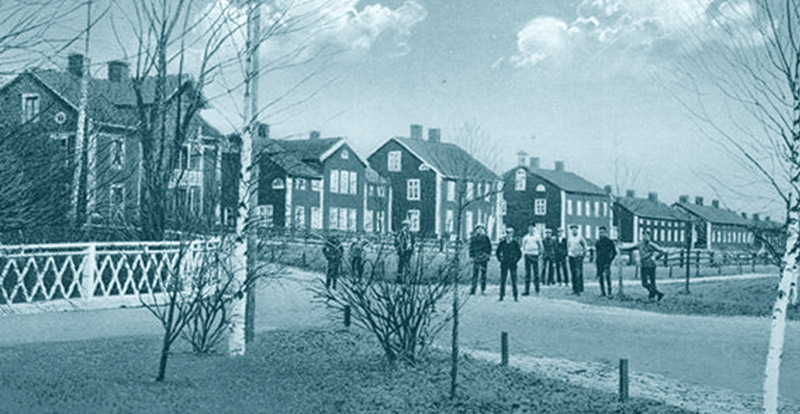
The Genberg family moved southwards on 6th August 1931 to Vivstavarv, a sawmill territory a few miles from Västernorrland’s main town, Sundsvall.
Filmjournalen magazine reported that “her father worked at one of the big sawmills.” The principal employer was the forestry and sawmill company Wifstavarfs AB, which also provided housing for their workers. The family’s move may have been economic, as their quality of life seems to have improved.
“I remember our house particularly vividly,” Hjördis recalled in her memoir.”It had an extraordinary atmosphere, and I think it characterised my childhood.”
“It was situated on a hill overlooking the bay and was referred to locally as ‘Kråkslottet’ (The Rookery). It was old, built of wood, and had a tower. The building was split into three separate dwellings. We lived in the middle one, which had a balcony. The French balcony had a wonderful view of the bay, and on dark winter evenings, you could see all the sawmills around the bay glittering like jewels”.”Kråkslottet was known to be haunted, and I firmly believe it was, even though I never experienced any direct evidence. One room especially scared us children and fired our imaginations. It had a dark green wallpaper with a gold pattern and a large, dark green tiled stove.”
“None of us children dared go there alone after dark, and I was the most afraid. Of course, my older siblings knew this and took advantage! I can still visualise all the children sitting in a row on the boot rack outside ‘the ghost room’. The older siblings told hair-raising ghost stories, and my brother stuck his hand behind the coats and gave me a sudden nip on my neck. I was beside myself with fear and ran screaming into the bedroom that I shared with my two younger sisters!”
“Now that I think back to my childhood, I can see how our fantasy world was dominated by thoughts of ghosts. I reckon it was due to the long winter evenings in the north and children’s imagination in that creaky old Kråkslottet. Fear of the dark and of ghosts has been there my whole life, and I am absolutely convinced that there are things we can not explain.”
Fate strikes again

“I wasn’t only afraid as a child, I was also unusually skinny and strikingly ugly, with lank flaxen hair. The only things I had going for me were a pair of huge grey eyes. For some unknown reason, my siblings called me ‘Fate’. I don’t know why. It could have been because of my peculiar appearance!”
“My siblings, on the other hand, were remarkably beautiful, especially my brother and the sister who was closest to me in age (Ann-Marie). She had long, thick, dark brown hair that I was always violently jealous of and was never as painfully thin as me. They used to say I was so thin that if they threw a loaf of bread at me, it would get sliced!”
“All of this sounds like I had an unhappy childhood, but that is not true. We actually had an unusually bright and happy childhood. We had fun together, and our parents did everything possible to make life as good as possible. In winter, we went skiing, and in summer, we swam. I have never been especially fond of winter sports – David and the boys can testify – but I love to swim.”
Pour a bucket of water on her
“My first memory concerning clothing comes packaged with my first memory of illness. When I was six years old, I got appendicitis and had to have an operation. When I recovered, I got my first ‘own’ dress. That is the first dress that was not inherited from my older sisters. I’ll never forget it. It was red with white dots and had a lovely skirt.”
“I also remember my first silk tights. I got them long before I was old enough to own such grown-up clothing. It was because my older sisters got a pair each for their graduation. I was so beside myself at the thought that they got those coveted items, not me, that I lay on the floor and screamed until I was given them. I’m afraid that was an approach I used to use, both when I wanted something and when I became angry.”
“I was awfully moody as a child – I still am, but now I try to control it – ask my husband if you do not believe me! I used to have terrible tantrums, and finally, Mamma went to the doctor to ask for advice. He laconically advised her to ‘pour a bucket of water over the kid’, but my mother didn’t have the heart because I was so small and thin.”
“My physique was helpful in other ways. The children had to help at home from when we were small. The girls had particular dishwashing days, but I often managed to escape as I was considered so delicate. This naturally annoyed my sisters. When I think back, I realise I must have been a troublesome young lady.” (Hjördis, we believe you.)
“Even as a little school kid, I had boyfriends and spent a lot of time thinking about boys. I particularly enjoyed taking away my older sisters’ boyfriends. They may have been considerably prettier than me, but I was smarter.”
Next page: Life was never the same again, 1930-1940
 Hjördis Genberg Niven
My grandmother Gerd was Hjördis sister. Both my mother and grandmother died before I was a teenager. I havent had any contact with any of the family on my mothers side. Thanks for the insight to my familys past.
LikeLike
Her father was my great grandfather’s brother, and he was definitely 100% Swedish.
LikeLike
I saw an old film with David Niven and remembered that his first wife died tragically. I read a brief summary of his second wife and wanted to find out more. Your articles seem very thoroughly researched so thank you
LikeLike