
“Of course, I knew who David Niven was,” Hjördis told a Swedish journalist, “but I wasn’t an expectant fan with my heart pounding as I stepped into the film studio – I was just a regular, curious visitor.”
“It was so quiet and peaceful. It must have been a break. So, my friends and I sat in a corner where there were some empty chairs.”
“I made myself comfortable in a canvas-backed chair. I never looked to see if there was a name on it. In fact, I didn’t even know that all the important people on a film set have a chair with their name on it.. or that it’s an unforgivable sin for anybody else to make use of it – especially nonentities like me.”
“I headed for my chair, plainly marked DAVID NIVEN, only to find it occupied,” David remembered. “The picture had gone over schedule, and I was tired and upset that day, so I told the assistant director to get her out.”
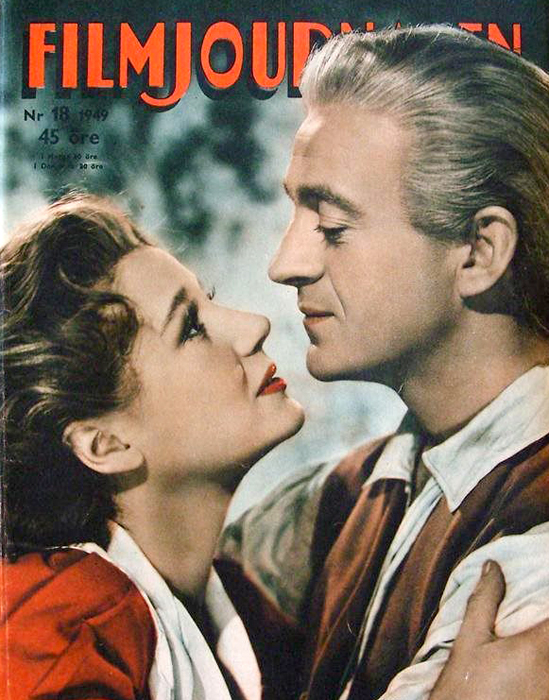
“Soon I was asked to move because ‘Mr. Niven wants his chair.’ I thought this rather rude and said so. Shocked looks and whispers all around.” [She must have appeared to be ‘a proper little madam’].
“A blonde man came stamping on the set, scowling and obviously in a bad temper. Then he marched straight up and said ‘I’m David Niven.’ He looked divine in his Prince Charlie costume.”
“It sounds silly to say it was love at first sight”, Hjördis said soon afterwards, “but I’m sure it was.”
“At that time I had not seen a film of David’s because I’ve always preferred reading to going to the movies. But I had seen pictures of him.”
“I suppose he thought that I would leap out of the chair with profuse apologies for my sacrilege. But, in my innocence, all I said was: ‘I thought your hair was dark.’ ‘It is’, said David, obligingly pulling off his royal blond wig. and thereby, with a charming gesture, destroying two hours of meticulous work in the make-up department. His obvious bad temper was because he had been dismissed from the set for the day with his work finished, and now he was being recalled to shoot the same thing all over again.”
“I noticed him stealing a second look at me. Perhaps it was my red-gold hair – which in those days hung down to my shoulders – that mollified him.”
“Or maybe he realised that it was not a gentlemanly thing to be rude to a visitor from abroad, for he must have known from my accent that I was not English. At any rate, he soon regained his good humour and we were chatting in a friendly fashion. He didn’t even ask me to get out of his chair!”
“I had never seen anything so beautiful in my life,” David later wrote. “Tall, slim, auburn hair, uptilted nose, lovely mouth and the most enormous grey eyes I had ever seen.”
“We chatted a lot and laughed a lot, and I thought: What a charming man this film actor is!”
“David has a wonderful way of making every woman he talks to feel important and attractive.”
“I explained that I had both designed and modelled clothes for a Swedish fashion house and also ran my own fashion page in a woman’s weekly magazine.”

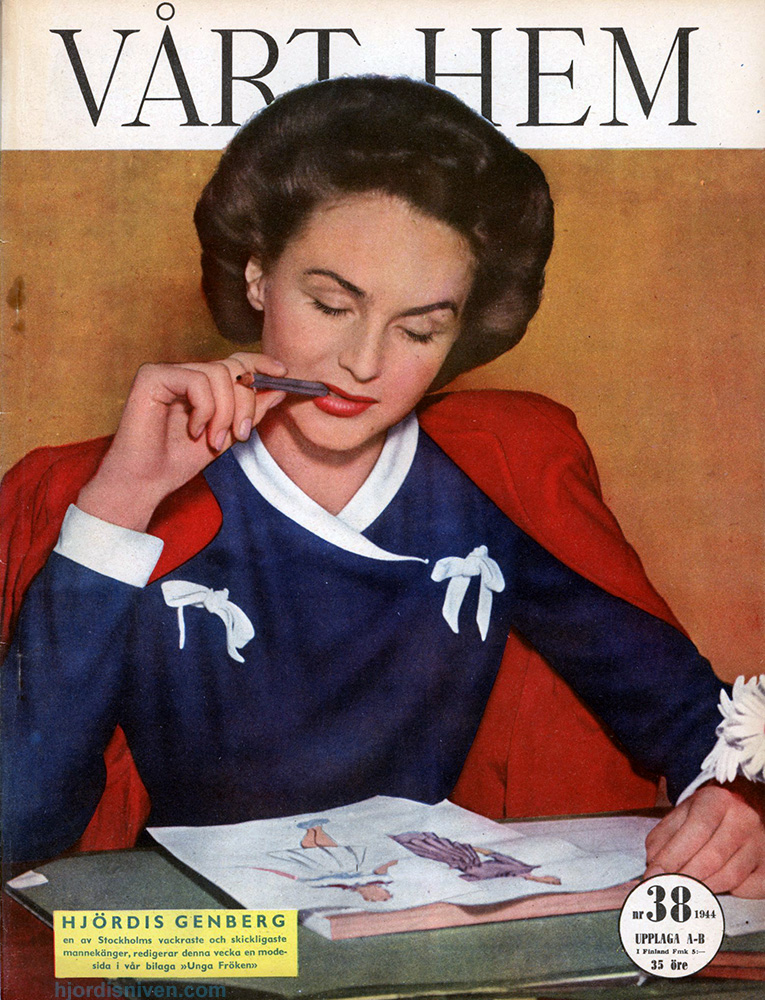
Well, we know that Hjördis modelled for NK’s Franska, but I’m not so sure that she designed clothes for them – at least not any that were made. As for her own fashion page in a weekly magazine, it looks as if a guest-editor slot in the September 1944 Unga Fröken fashion supplement for Vårt Hem, and a heavily advertised fashion feature in the 3rd December 1945 issue of Vi Damer, were strictly one-offs.
Far from running the page in Vi Damer, the staff writer had to virtually crowbar fashion tips out of a reluctant model who was probably more concerned with packing her bags and following Carl Gustaf Tersmeden to the USA:
“At first, Miss Genberg tried to get away with the uncomfortable explanation that the art of wearing clothes is innate. However, as that would condemn thousands of women to eternal hopelessness [bit dramatic], she thought about it again.”
Stout and Champagne
“Among David’s many virtues, he is a fabulous listener. In fact, he has cultivated it as an art. That day on the film set it worked right enough. I was charmed, captivated, and enslaved by this man. The funny thing was I really didn’t know anything at all about him. I had never actually seen any of his films and had only rather vaguely heard his name.”
“At the end of the filming on the day we first met, he said to me: ‘Have you ever been to an English pub?’ ‘Never’. ‘Let’s go to one then.'”
“He took me, along with my friend and his director, to a little riverside pub. There we played darts, drank pints of beer and then he asked me: ‘Have you ever had Black Velvet?’ which I soon discovered was stout with champagne. And, as young as I was, I was conscious that he was showing off in front of me, just like a young lad with his first girlfriend. I cannot deny that I loved him for it.”
“We had a very nice time, and I remember thinking that it was a long time since I’d had so much fun and laughed so much.”
“When we left he said: ‘You’ve seen a typical English pub, now you must see a typical English club. I’ll pick you up tomorrow.'”
“So, the next day he took me to lunch at Bucks. I don’t remember much about it. I only remember David, so sweet, so gay [old meaning of word!], so charming.”
“That was nearly our last meeting.”
Cocktails, phone calls and hatred

“He was going away to stay with friends in the country for the weekend, and so was I. He suggested that he should call for me on Sunday evening and bring me back to town. ‘I’ll ring you first and let you know what time I’ll be along for you.’ he promised.”
“All through the weekend, I dreamed about him, but Sunday morning came, Sunday afternoon and Sunday evening, and I did not get a telephone call from him. I became frantic.”
“Funnily enough my host and hostess couldn’t stand my woebegone face any longer. In the end, I went back to London with some of the other guests. I felt deeply depressed and thought it was shameful of him. At the same time, however, I was worried, in case something had happened to him.”
“On Monday, I was still waiting to hear from David. But he did not call. I became angry. I knew that nothing serious had happened to him; otherwise, it would have been in the newspapers.”
“On Tuesday evening I was at a cocktail party with some of the people with whom I had spent the weekend. A cheery, red-faced man sauntered up to me. ‘Well, have you seen David Niven?’ he asked, giving me a wink.”
“‘What do you mean?’ I demanded, taken aback.”
“‘He rang up on Sunday morning when you were out for a walk. I thought I’d play a joke on him so I told him you’d gone back to London with another chap.'” [I assume that a comedy career did not follow].
“I left the man without a word, went straight to the phone and rang up David in his hotel suite. Luckily, he was in. I was nearly in tears as I told him the story. he didn’t comment but just said: ‘What are you doing now?’ ‘I’m at a cocktail party with a lot of horrible people,’ I told him, ‘I hate them all – every one of them.’ And at the time I really meant every word of it.”
“David said: ‘I’ve got to be on the set at the crack of dawn. Come and have an early dinner with me.'”
At least, that’s the 1964 version. In 1957, she described David’s reply to her phone call rather differently:
“He said, in a voice which I like to think was shattered with emotion: ‘I thought you were so awful I wasn’t going to call you ever again’.”
Next page: A marriage proposal
 Hjördis Genberg Niven