
“I enjoyed being back home,” Hjördis remembered. “It was a beautiful spring, followed by a fabulous summer that we spent almost exclusively on my husband’s yacht, Symfoni. I know of almost nothing better than sailing, and Symfoni was a fantastic yacht that even the worst ‘land crabs’ could enjoy.”
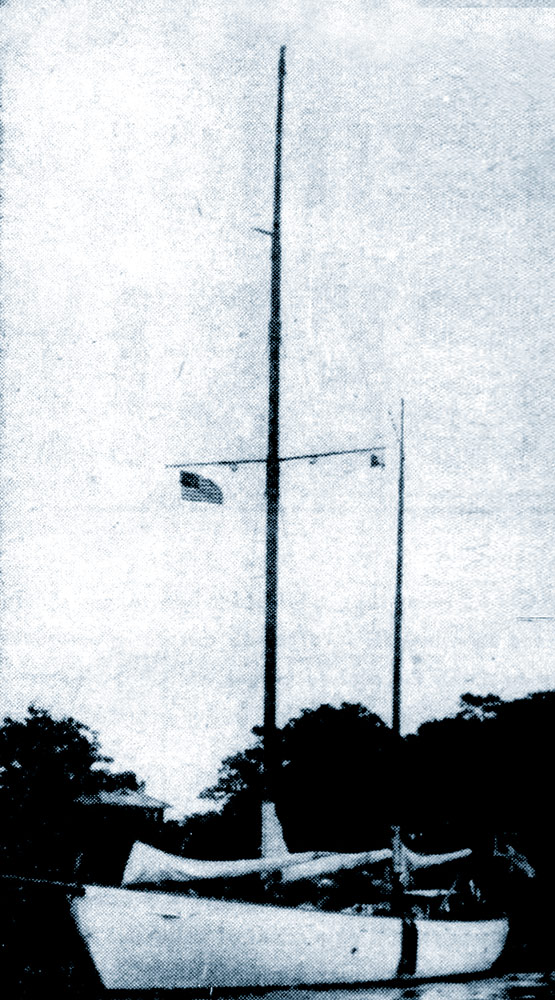
Symfoni was a 59-foot ketch built entirely of Honduran mahogany and teak. It was purchased by Carl Gustaf shortly after its completion in 1937 by the Plins Boatyard, Stockholm.
He claimed to have taken it on jaunts to England, France, and “all” Baltic ports before the Second World War broke out. [Bet he didn’t]
Allas magazine’s modern-day Cinderella story described Hjördis’ “everyday life” in Sweden during the first half of 1946:
“When the Tersmedens returned to Stockholm, they rented one of the most elegant flats on the whole of Strandvägen. One party followed another, champagne corks popped, they sailed in a fleet of yachts, and drove around in their handsome car.”
The Swedish tabloid press enjoyed making fun of ladies dipping their toes into Swedish society. Aftonbladet warned them of clichés to be avoided:
“Do not go out to Sandhamn Island in Tersan’s boat. And whatever you do, do not let yourself be photographed in the rigging as a figurehead with a backdrop of white clouds. [Oops. See photo]. Never sit in (racing driver Henken) Widengren’s car. And do not go with (writer) Kar de Mumma to the races in a stupid hat with birds on top.”
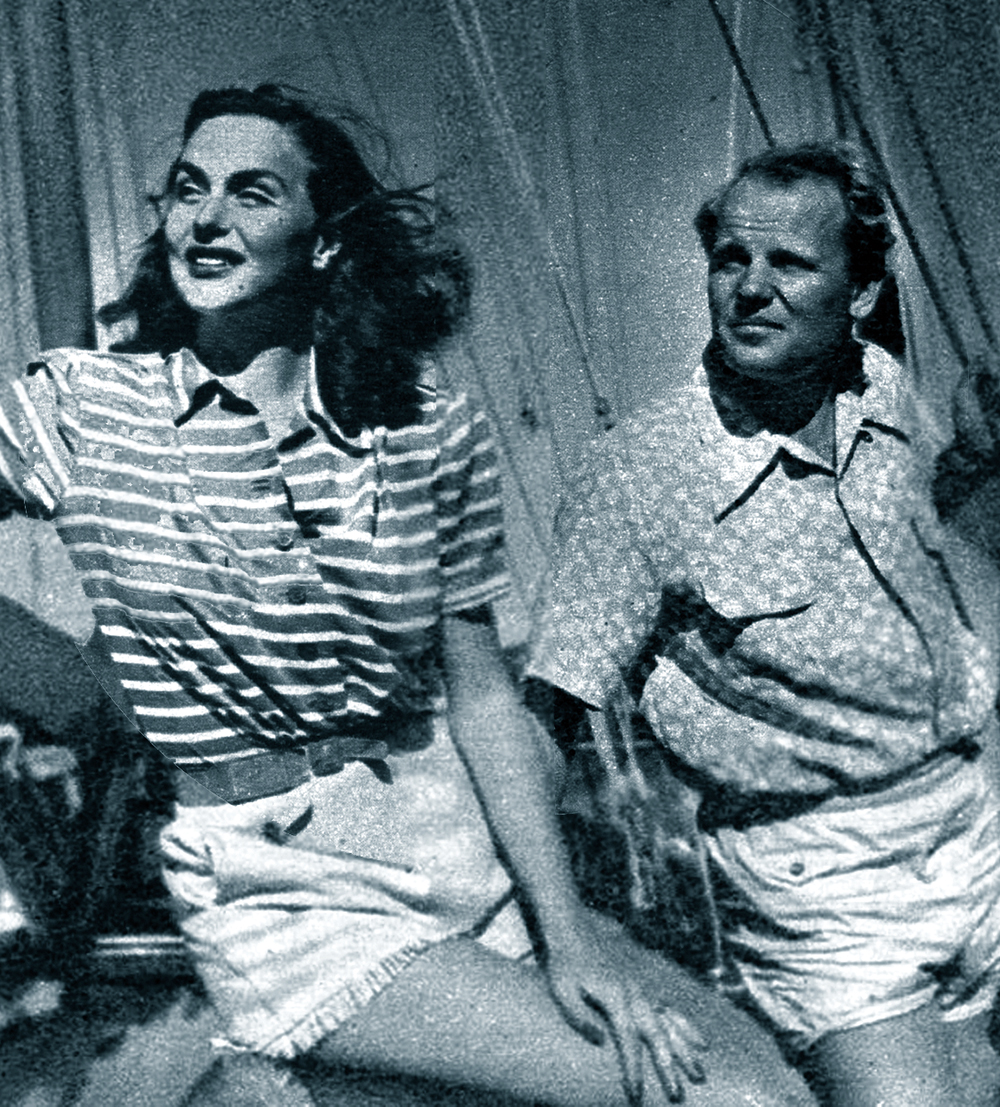
“Do not be like others. Be original. Lock yourself in an attic where it’s nice and stuffy.” Here endeth the sermon.
Talking of attics [Call that a link?], Carl-Gustaf bought the flat in Strandvägen. It was described in the Svenska Dagbladet as: “Extremely tastefully decorated. It stands out significantly against all the furnished flats on other floors usually offered to diplomats.”
“The only inconvenience is, (brace yourself), like most apartments, it hasn’t enough space for all the required servants.” Only two live-in servants could be accommodated. Other staff had to “come and go.”
It was all a long way from life in sawmill workers’ housing in Vivstavarv, but Hjördis quickly adjusted and had servants and housekeepers for most of the next 50 years.
A bit of a car crash
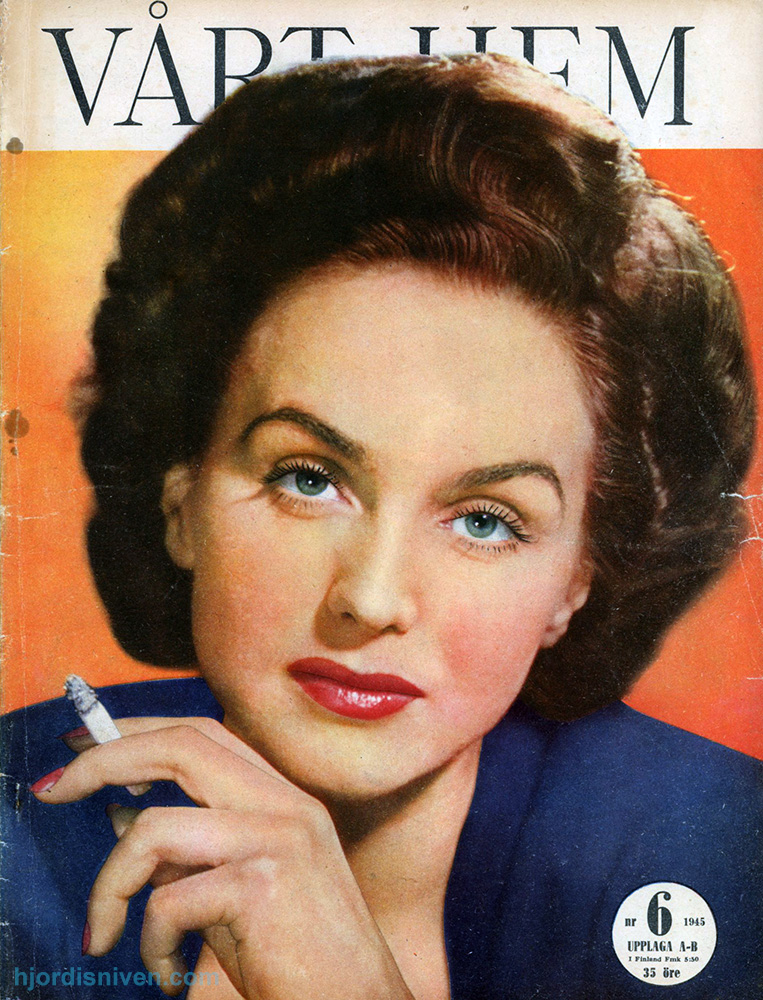
Hjördis’ marriage changed her from being “Stockholm’s most beautiful star mannequin” into a highly visible star socialite, which she became uncomfortable with.
As the story entered the second half of 1946, any potential “and they lived happily ever after…” conclusion began to unravel.
“Marriage with Lieutenant Carl-Gustaf Tersmeden gave Hjördis an apartment on Strandvägen, cars, sailboats, trips abroad … everything she could ask for. But apparently it was not enough.” Filmjournalen 1950
Following the 10th January 1945 announcement of her engagement to the high-profile Carl Gustaf, Hjördis received press attention that quickly eclipsed her modelling work.
By the spring of 1946, she was listed as one of Sweden’s best-known women, along with fellow society girl Margareta Widengren (wife of Henken) and magazine editor Kerstin Wijkmark. Kerstin had stirred up controversy by marrying King Gustav VI’s youngest son, Carl Johan, in New York three days after Hjördis and Carl’s wedding.
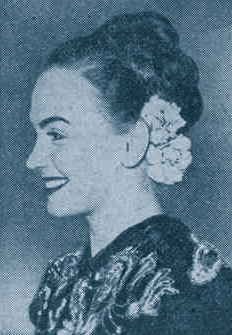
Hjördis was regularly name-checked and scrutinised at society gatherings: “Hjördis Genberg-Tersmeden wore an American black velvet dress with a gold embroidered scallop collar and a wreath of carnations in her hair.” (September 1946)
The (primarily fashion-and-lifestyle-related) press attention reached a crescendo in September, along with a simultaneous rise in gossip about her private life.
Allas starkly reported that “Carl-Gustaf Tersmeden could not be faithful to her.” (Surprisingly, the first mention of this unsurprising statement only came to light four years after I started putting her story together ).
As a reaction, Hjördis’ actions became more extreme. She “carelessly sprinkled money around” and was involved in a high-profile accident when she crashed a car into a lamp-post in Stockholm.
She received only minor injuries but, according to Allas, “was not quite sober.” [Subtle description. Can’t have an inebriated Cinderella…]
One newspaper said she had persuaded a professor to let her drive his car: “The learned man could not resist her begging so beautifully,” leading to the lamp-post and a positive blood test at a police station.

Hjördis Genberg-Tersmeden’s “life of considerable Stockholm luxury” (description c/o David Niven’s biographer Sheridan Morley) was further blemished on 2nd November 1946 by the death of her mother, Gerda Paulina Genberg.
On 26th November, visas were secured for Hjördis, Carl Gustaf, and their somewhat bruised marriage to return (or escape) to America, this time for a planned twelve-month stay based in New York and Palm Beach.
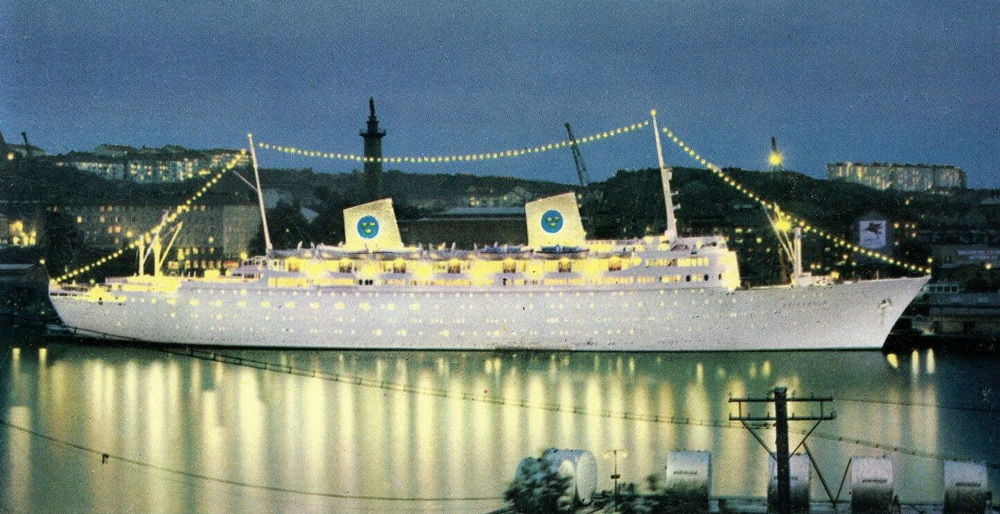
Homesickness was avoided by opting for Christmas in Sweden before they set sail on the ‘Gripsholm’ from Gothenburg on 3rd January 1947. They were joined for the voyage by another of the best-known Swedish women of 1946, Margareta Widengren, and her husband, Henken.
To see and be seen.
The Swedes arrived in New York on 14th January. Before joining East Coast society’s winter migration to Miami Beach, they spent a few days at the exclusive Drake Hotel and visited the nearby El Morocco nightclub, one of the prime society destinations to see and be seen.
And Hjördis certainly was seen by an influential society gossip columnist for the Hearst newspaper chain, the aristocratic White Russian émigré Igor Cassini:
“Hjördis, grey-eyed, auburn haired, and with a body to take your breath away. In fact, when I first saw her at El Morocco, I was still gasping as I made discreet inquiries, only to be told that she was on honeymoon with Carl Tersmeden, the young and handsome, rich Swede at their table. I was terribly struck with this creature, curves… very, very beautiful. They all told me ‘forget her Igor, she’s a bride.'”
Originally Igor Alexandrovich Loiewski-Cassini, he signed his first by-line as Igor Loiewski-Cassini, only for his editor to say, “What’s that thing in the middle?” There followed a further crop to Igor Cassini, although even then, he was referred to as “that fellow with a name like a sneeze”.
In 1945, he inherited a massively popular syndicated society gossip column written under the totally ridiculous by-line Cholly Knickerbocker, where his mix of “acid and froth” had the power to make or break careers.

As author William Stadiem points out: “He wasn’t some ink-stained outsider looking in; he was a titled European count looking down, and America ate up every word.”

Igor’s widely syndicated ‘Worst Dressed Men’ list in January 1947 featured a selection of senators, ambassadors, mayors, very, very rich people (i.e. Howard Hughes) and Bing Crosby. No one was immune.
The “winner” was conductor Leon Stokowski: “Pink shirt, yellow tie embellished with hand-painted nudes, red socks, moccasins and a plaid jacket.”
The thought occurs that Leon used his sartorial choices to get noticed. If so, mission accomplished. Indeed, not being included could be an insult: “We understand that a wealthy gent around town has been kicking our name around because he was ignored in our recent listing of the world’s ten worst dressed men,” Igor wrote. “So, you’re wearing clothes now.”
A bizarre backlash from male readers resulted in a staggeringly bold ‘Worst Dressed Women’ follow-up in February, headed by Queen Wilhelmina of The Netherlands and the late President’s widow Eleanor Roosevelt (!). And Igor got away with it: “I instinctively enjoyed the shooting down of sacred cows.”
One part chic, the other Lower Slobdovia
And now, a short interlude describing New York’s two leading society haunts, courtesy of Igor’s brother Oleg Cassini (then a Hollywood dress designer married to the film star Gene Tierney):
“The Stork was where the debutantes, the post-debs, and the models would go. The main room was a safe, chaperoned sort of place. El Morocco, by contrast, was a naughtier sort of place. It was darker, with gaudier-blue-and-white zebra-stripe banquettes, white palm trees everywhere, and dark blue walls with little stars, representing the desert night, I suppose. It attracted a more sophisticated, continental crowd. I might meet the right sort of girls at the Stork, but I would take them to El Morocco once we got past the initial pleasantries. El Morocco was where one ended the evening.”
Igor’s preference for El Morocco reflected his love of mixing work with play: “My evening haunt was El Morocco. That is where one found beautiful girls along with celebrities and society. Placement was vital. One part was chic and the other, Lower Slobdovia.”
“I was a man so snugly married, it seemed safe to stray.”

When Igor was on the prowl at El Morocco with sights set on Hjördis, he had been married for over six years to the landowner’s daughter and fellow gossip columnist Austine “Bootsie” McDonnell.
His first impressions of her were: “Titian hair, flawless skin, and a high forehead of flawless proportion.” [Eh?] “Funny I should remember the forehead. With most people – especially a pretty girl – it is not a feature you notice right away.”
By 1947, their relationship had entered what he described as its “weekend commuter stage”, with him based in New York and her in Washington.
“Left to my own devices during the week,” Igor admitted, “and invited everywhere because of my by-line, there was a sharp increase in my sex life. Such are the gains of power; glamour girls suddenly grew on trees.”
“I entered my smorgasbord phase, first with model Inga Lindgren. Inga was a stunning Swede who had worked as a model and had been married to a German millionaire.”
Inga divorced her husband Alfred E.Goldschmidt in Reno, Nevada (more about there later) on 1st July 1946 because: “Our marriage was a terrible mistake from the beginning.” They had initially fled France together ahead of the German invasion in 1940, reaching an Italian port just before Mussolini decided to join in.

Igor signalled his interest in Inga by gushing in the Cholly Knickerbocker column on 22nd September 1946: “The most beautiful sight around Manhattan in months, Inga Lindgren, Swedish beauty recently divorced from a millionaire refugee.”
“For a while, it looked serious,” Igor wrote in his autobiography, “but not enough for me to break with Bootsie, who wisely kept a closed eye.”
Of course, if Bootsie ever wanted to know what Igor was up to or wanted to get up to, all she needed to do was casually decypher the Cholly Knickerbocker column. Regularly. Inga was soon cast aside:
“Gianni Agnelli [the multi-millionaire head of Fiat and a childhood friend of the Cassini brothers], still in his roaring playboy stage, met Inga through me and invited her to Italy. She went, secure that I would follow. I never joined her in Europe because I had fallen in love with another Swede by then.” Shallow or what.
As an aside, Gianni Agnelli’s 1948 conquest was Pamela Churchill, the former wife of Winston’s son Randolph. “I’m a great friend of your ex-daughter-in-law Pamela,” an acquaintance said to Winston Churchill. “I understand she’s going around with a fellow who owns a garage in Turin.”
Next page: Cholly Knickerbocker observes: Hjördis Tersmeden, 1947
 Hjördis Genberg Niven