Maj-lis Genberg
Hello everyone. Sorry to start with the sad news that Hjördis’ niece, Maj-lis (Mia) Genberg, passed away in 2025. Her twin sister Gudrun (Pia) died in 2020.
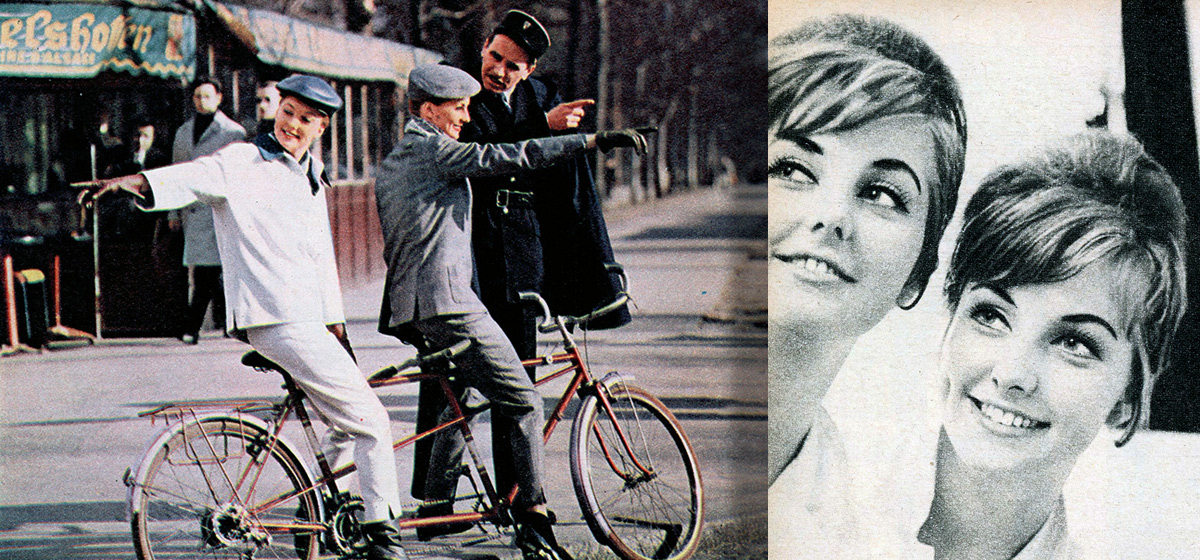
The twins worked as models in Sweden before gaining fame in 1959 as Folies Bergère showgirls in Las Vegas. After their return to Europe, they enjoyed huge success as Jean Patou fashion models in Paris, with an additional reputation for changing outfits with astonishing speed, until audiences realised they were twins.
The article below appeared in Hemmets Veckotidning after an early 1961 visit by the magazine’s Paris correspondent, Greta Merlier. It captures a snapshot of the teenagers’ lives as they prepared to move from modelling careers in Paris to movie careers in Rome.

“Pia and Mia Genberg have been inseparable for 19 years—and they love it. Their shared, double dose of charm has taken them to the fashion houses of Paris, where they stroll hand-in-hand through the showrooms, greeted with cheers from enthusiastic audiences. Next up: trips to Rome and Morocco to act in movies.
Pia was born first. Ten minutes earlier, to be exact. Pia’s eyes have a bit more violet in them. Both sisters have deep dimples when they laugh, but Pia also has one near her eye. “That’s not a dimple,” she says. “It’s a scar—from when I fell into the bathtub as a toddler.”
Mia is slightly fairer. But are those really their names? Not exactly. Foreign journalists who struggle with their tricky Swedish names gave them those nicknames. Their full names are Gudrun (Pia) and Maj-lis (Mia) Genberg. Their Aunt Hjördis is married to David Niven—just in case anyone in Sweden still doesn’t know that fun fact.
Right now, they’re in Paris modelling clothes for Patou.
“We’re getting our hair done by a top stylist before tonight’s dress rehearsal—come with us…”

The hairdresser has his salon near Rond Point. He melts with pride when faced with these Nordic beauties, their permed locks ready to be styled. He brushes and curls their hair, pins it up, and repeats the process multiple times. The girls are patient and calm. Fifty thousand pins might be needed to hold it all together. That’s just how it is here.
After two hours, they look like someone who’s been out in a hurricane. “Voilà,” says the strong-armed Figaro, but they’re not quite convinced. They pay their 35 francs and are told they got a “double discount.”
During this time, they had their portraits taken, which made them nervous. You never know how the twins will turn out in photos—especially when one insists on being photographed from the right side. The next day, the photos were reviewed and approved.
Patou kicked off the fashion show with a bang. The models were stunning, the setting was elegant, and the show lasted an hour, with the twins making several appearances. Jolie’s assistants were amazed. “We’ve never seen anything like this,” they said. The girls were proud of their product.
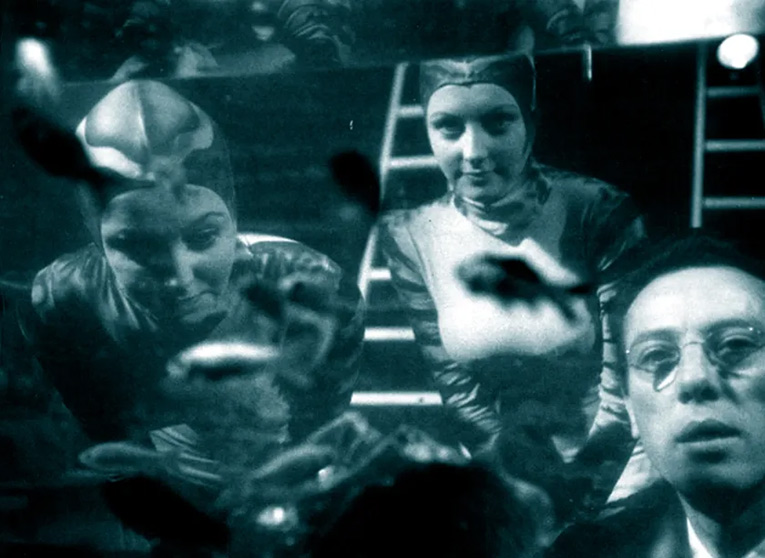
Paris is very into the twins. People chase the duo down the street, snapping photos and asking for interviews. Radio and television have been all over them. They sang “Små grodorna” (“Little Frogs”) and “The Girls from Småland” in Swedish—it takes quite a bit of fame to get “The Girls from Småland” played on French radio. But Mia and Pia pulled it off.
They love food. Yet they have 55 cm waists and figures that outshine both Monroe and Bardot.
“Meatballs, oh how I miss meatballs… and falukorv (smoked sausage), herring salad, and mashed rutabaga (swede),” Pia adds.
They’re simple, natural, and easygoing. Back home in Farsta, people don’t make a big fuss over them. Their eyes don’t light up when talking about Las Vegas, boys, or clothes—but mention mum’s cooking or Bernardo’s meals, and they beam. (Bernardo is David Niven’s chef.)
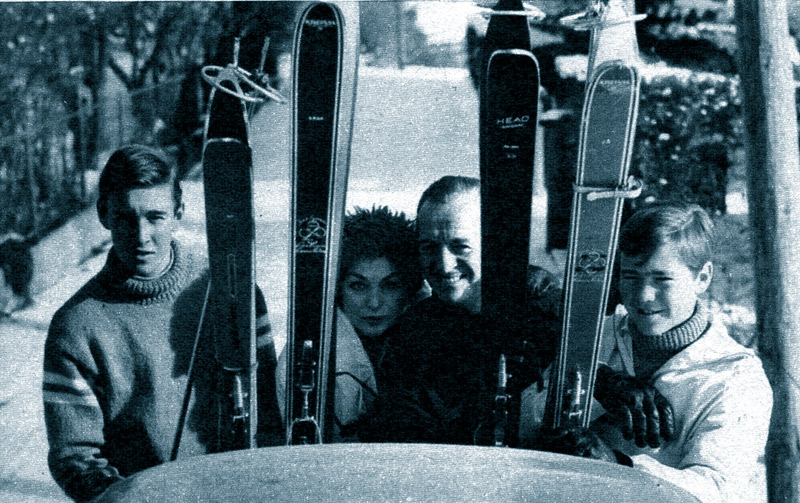
“We had such fun when we visited them in Switzerland a month ago. They have a villa in Château d’Oex. We all went skiing—and we all fell down. It’s beautiful there, and not too high up, so you don’t lose your breath.”
[Hjördis was not put off, and fell again in 1962, breaking her leg in fifteen places. Her injury slowed her down when John F Kennedy decided to play ‘chase’ in 1963.]
In December 1960, Hjördis and the twins surprised David with a Lucia celebration. He had no idea! They found white robes, made wreaths for their hair, and whipped up something that resembled lussekatter (Lucia buns). They spent all night preparing the tray, getting dressed, and fixing the candles. Then they woke him up at an ungodly hour with their Lucia procession.
You can easily imagine David Niven’s shocked expression when three candlelit girls show up at dawn. But he didn’t stay in character—he joined in the Lucia celebration.
“He’s so sweet. He gave us a trip home as a Christmas present,” they say. “And Hjördis gave us these,” the girls add, showing off cute gold watches hanging from long chains around their necks—just the thing if you want to stay fashionable.
People have written that you like aquavit? (a traditional Scandinavian distilled spirit, similar to gin)
“Ugh, yes, they write so much nonsense. Have we said that we like aquavit? We only drink milk and Coca-Cola. But it’s true that we enjoy sleeping in late in the mornings—when Louis doesn’t start singing!”

Louis is a Spanish jack-of-all-trades who came with the apartment they were given. But Louis isn’t the only one catering to them—they also have a manager who doubles as their photographer, Gérard Décaux, two secretaries (one Swedish, one French), and a massive bodyguard named Lucien, a former French wrestling champion. Last year, Lucien stood like a wall between Brigitte Bardot and the French press when she was expecting her baby. That was nothing compared to looking after the twins.
Lucien rarely has both girls under control at the same time—one always sneaks off, and they blame each other. Poor Lucien can’t tell them apart and is on the verge of a nervous breakdown. Photographer Gérard Decaux has ordered him never to let either girl out of his sight—not so much for safety, but for publicity!
Lucien also works as a stuntman in films that require daring action scenes. But he wouldn’t dare raise his voice at Pia or Mia. Their angelic charm hides a mischievous streak. They’re never rude, never sick (knock on wood), and when one dreams something, the other dreams it too.
Do they like Paris?
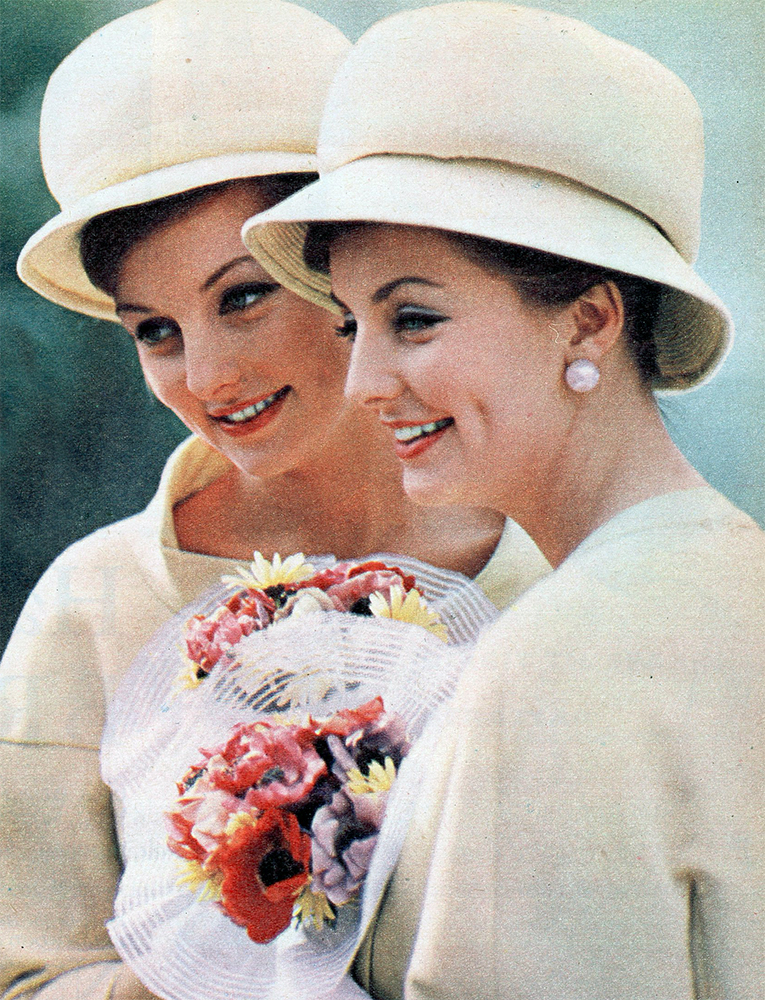
“Oh yes! But it’s a bit sad— In Paris, there’s so much tempting shopping, but we can’t afford it.”
The twins invited guests to a party at their home one Sunday. Technically, it’s the home of Gérard Décaux, the impresario-photographer, but he had lent out the flat and was staying at one of the hotels owned by his parents in the meantime. Gérard is a skilled photographer. We counted twelve cameras, and his photos and cover girls from all nationalities adorned the walls.
Guests chatted about quiz shows—favorite sports, actors? The twins answered sweetly: blue, ice skating, swimming, horseback riding, and skiing. Their top favorite? David Niven. Then Elvis Presley, Marilyn Monroe, and Shirley MacLaine. Their upcoming plans included a two-day visit with the Nivens in Switzerland and a role in the film The Last Days of Sodom and Gomorrah, starring Anouk Aimée, Pier Angeli, Stewart Granger, and Stanley Baker.
Like many young women, the twins dream of America and Hollywood. They’ve had offers—so why not? I’m pretty sure they’ll make those dreams come true.”
For more about Gudrun and Maj-lis, we have a page dedicated to both of the twins.
Slightly surreal thanks to Copilot for help with the translation, though I’m pretty sure the Swedish-to-English for Marilyn Monroe isn’t “Maria Montez.” And goodness knows why it decided to insert “science fiction in England” into the twins’ plans between visiting the Nivens in Switzerland and going to Rome.
That said, Copilot did a very good job of aligning a very out-of-register photo used near the top of this page. For anyone interested, here are the before and after:

Guest star for three seconds
Well, I’ve finally found Hjördis’s last Swedish movie appearance: 1945’s “Brita i grosshandlarhuset” (Brita in the Merchant’s House), only available on DVD as part of a four-movie box set. She is listed in IMDb as playing the (uncredited) part of an officer’s wife.
Her appearance lasts for about three seconds, swooping into a chauffeured car outside her workplace, the NK store in Stockholm, as an open-mouthed Brita (recently arrived country girl) looks on. I guess Hjördis was listed as an officer’s wife because she was about to become one in real life. There is no sign of an officer in the scene. Anyway, here it is…
The story would have had some resonance with Hjördis. In short, Brita is the daughter of a poor crofter who arrives in Stockholm by train, clutching her suitcase, is awed by the sight of NK, and then sets off to report for work as a maid at the home of a wealthy businessman living on the Strandvägen. (Where Hjördis actually lived). She falls for the son of the house, but can they bridge the social divide?… Etcetera.
Filming on ‘Brita i grosshandlarhuset’ was completed on 28th November 1945, but Hjördis was not in Sweden for its premiere in February 1946.
“And so it was. I refrained from a possible career as an actress, and we started making plans for the future. It was decided that Carl Gustaf would travel to South America and that I would come over later and meet him in the US. “
Swedish Spring fashions in 1945
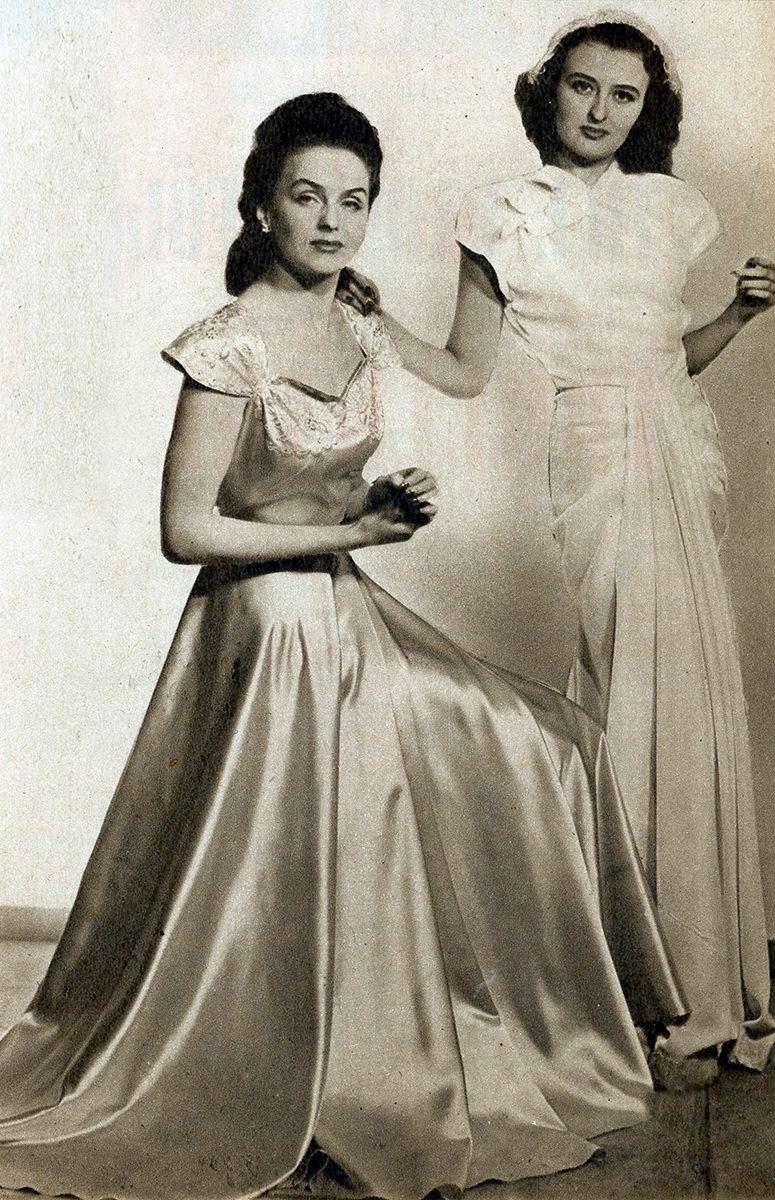


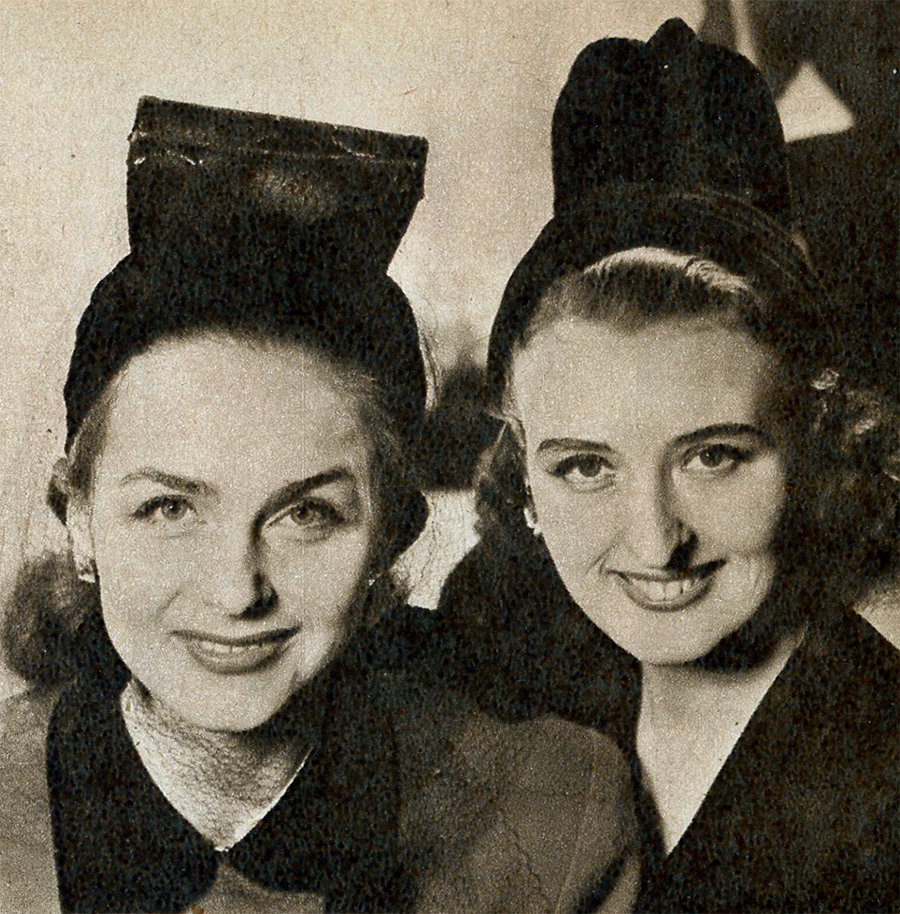
The March 1945 issue of Veckojournalen magazine featured a preview gallery of Swedish spring fashions, modelled by the country’s two premier models: recently engaged Hjördis Genberg and Sweden’s Twiggy, Kim Andersson, whose nickname was “The Plank”. “Twiggy” sounds better.
The new fashions were described by both Kim Andersson and Hjördis Genberg as “lacking any revolutionary ideas.” However, Sweden’s years of isolation and an easing of rationing were having an impact.
“The suit, as well as the dress, has now become the backbone of the wardrobe—whether inspired by American-style strict military uniforms or more imaginative romanticism. A characteristic of spring’s fashion commentary is also that they come in both full and three-quarter lengths. For evening dresses, Kim Andersson suggests the comeback of the fan (a long-forgotten detail) now welcomed as a sweet, decorative element.” So, military uniforms and a fan.
More about Swedish fashion in the 1940s, and wartime Sweden 1939-1945.
And that’s all for this post. If you’ve made it this far down the page, well scrolled. And Happy New Year!
 Hjördis Genberg Niven